Palo Santo smells like something between sweet orange peel, cedar and incense. Twenty seconds in a flame is enough to fill a room with scent for hours. Anyone who has smelled it before recognises it instantly. Anyone smelling it for the first time tends to come back for more.
Behind that scent sits a fairly specific wood, a fairly specific tree, and a fairly specific conversation about sustainability. This guide walks through what Palo Santo actually is, where it comes from, how to use it, and what to watch for when you buy it.
What Palo Santo actually is
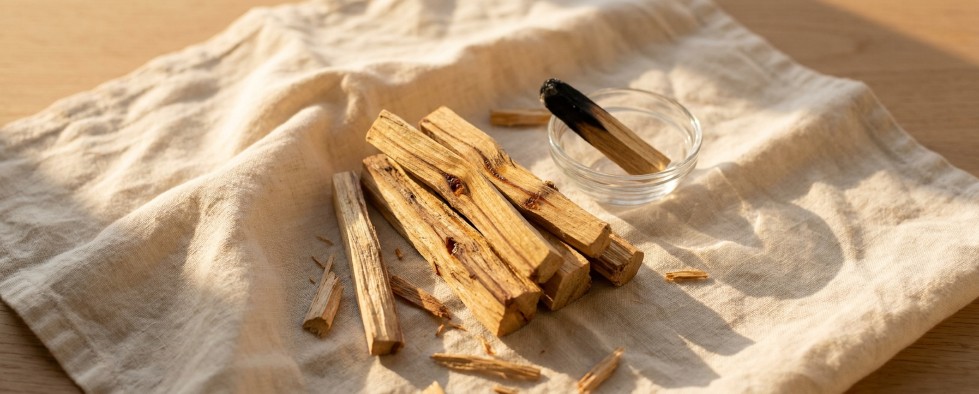
Palo Santo (Bursera graveolens) is the name for the resin-bearing heartwood of a small, gnarled tree that grows in the dry coastal forests of Peru, Ecuador, and parts of Bolivia and Brazil. The name translates literally as "holy wood" in Spanish.
What gives the wood its characteristic scent are the essential oils — chiefly limonene and α-terpineol — which build up in the heartwood only after the tree has died and spent years maturing on the forest floor. A freshly fallen Palo Santo tree barely smells. The scent we know develops only after four to ten years of natural decay.
This is the single most important fact in the whole story. Palo Santo worth burning comes from trees that died naturally and were allowed to mature on the ground for years. Cutting a living tree produces wood that has almost no scent and almost no value — to the ritual, and to the trade.
How the scent actually works
Palo Santo's scent is often described as sweet, woody, with a hint of citrus and a soft resinous undertone. That complexity comes from the specific composition: limonene (the same compound found in orange peel) provides the fresh, lighter top note, while resinous terpenes form the warm, dry base.
Compared to white sage, Palo Santo smells softer, sweeter, less smoky. Sage has a strong herbal, almost sharp undertone that some find pleasant and others find overpowering. Palo Santo sits closer to the world of incense or cedar than to herbs.
Another difference: a Palo Santo stick never needs long in a flame. You hold it in the flame, let it catch for twenty to thirty seconds, blow it out, and it smoulders on its own for a few minutes more. The scent released hangs in a closed room for well over an hour.
Where it comes from
The heart of the Palo Santo region is a fairly narrow strip along the Pacific coast: southern Ecuador and northern Peru. There the tree grows in dry tropical forests, often on hillsides, in an ecosystem that depends on the interplay of heavy rains, dry periods, and specific insect species.
Origin does affect scent quality. Peruvian wood is known for a drier, more citrus-forward profile. Ecuadorian wood often has a rounder, sweeter base. The difference is subtle — for most users only noticeable when smelling both side by side — but real.
Bolivian and Brazilian Palo Santo exists too, but comes from smaller stocks and makes up only a marginal share of what reaches Europe.
The sustainability story — why this matters
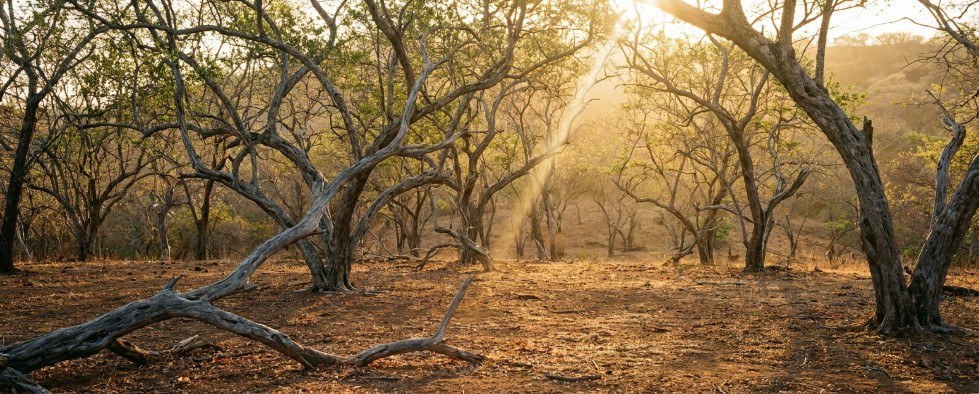
Palo Santo is not an officially endangered species on the IUCN list, but it is under pressure. The tree grows slowly, the wood needs years of natural maturation to be usable, and international demand has been outpacing what the forests can sustain.
The ethical line is clear: only wood from trees that died of their own accord, ideally after three to ten years on the forest floor. Ecuador has banned the cutting of living Palo Santo trees since 2008; Peru applies strict regulation and export quotas. But enforcement is difficult in practice, and wood from illegal or grey sources still circulates on the international market.
What this means concretely for the buyer:
- Ask about origin. A seller who can't tell you which country and which type of sourcing his wood comes from doesn't know himself.
- Scent quality is an indirect signal. Well-matured wood has a strong, complex aroma. Almost scentless wood typically comes from young, freshly cut trees.
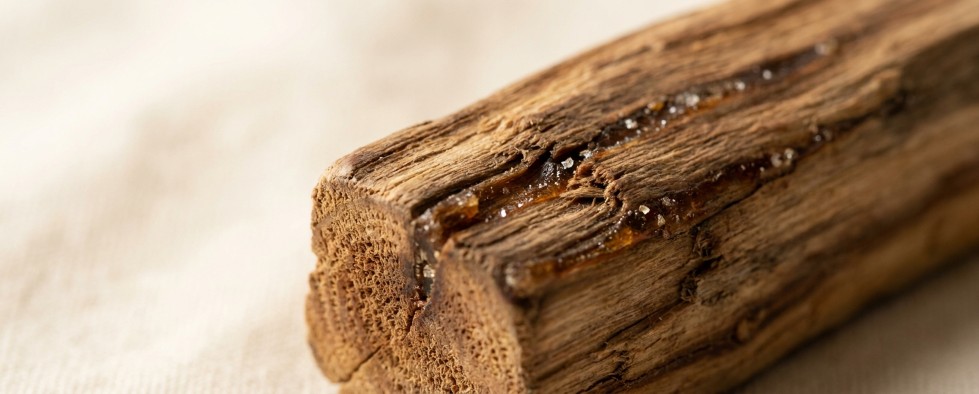
- Weight and visible resin. Matured wood is noticeably heavier than fresh wood and shows visible resin channels at the surface.
For the user the difference in experience between good and poor Palo Santo doesn't come down to what's printed on the packaging. It comes down to the chain behind it.
The different forms
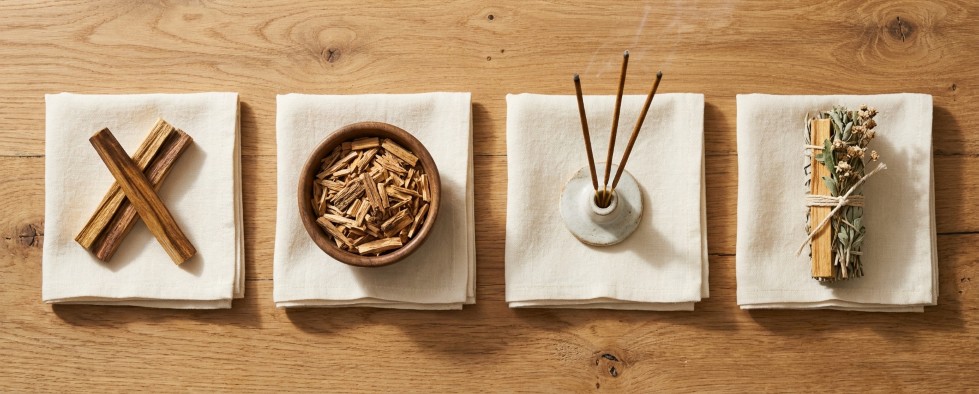
Palo Santo comes in a few clearly distinct forms, each suited to a different use.
Whole sticks
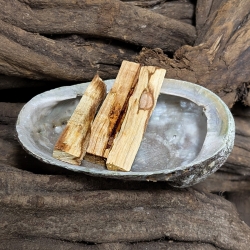
The classic form — small wooden sticks of a few centimetres, rough shape, visible resin in the better grades. Suited for traditional use: light one stick, blow out the flame, let it smoulder. Our Peruvian Palo Santo sticks are the standard.
Shredded wood
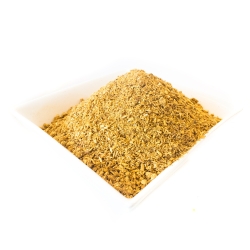
Small wood shavings or chips meant to be placed on a charcoal disc or in a charcoal burner. Gives a more intense, faster release of scent. Our Palo Santo Shredded works this way.
Incense sticks
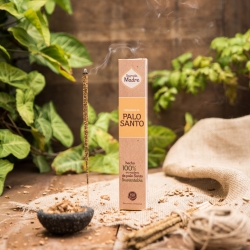
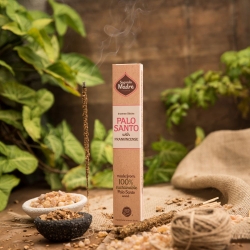
Palo Santo powder mixed with a natural binder and applied to a thin bamboo core. Burns like ordinary incense: light it, blow out the flame, set it in a holder. Practical for daily use when handling an open flame with loose wood isn't convenient.
Blends
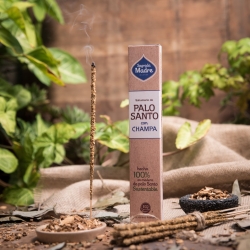
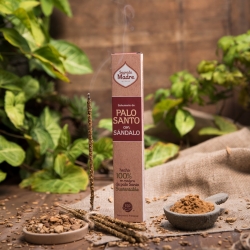
Palo Santo is often blended with other resins or woods: champa, sandalwood, rose resin, frankincense, myrrh. Each blend shifts the scent in a direction — more floral with rose, more resinous with frankincense, more South Asian with champa. For those who already know the pure Palo Santo scent and want variation.
Smudge bundles
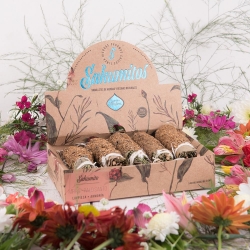
A bound bundle of Palo Santo shavings together with other herbs or resins, intended for the smudging ritual. See our smudging ritual guide for how to do that.
How to use a stick
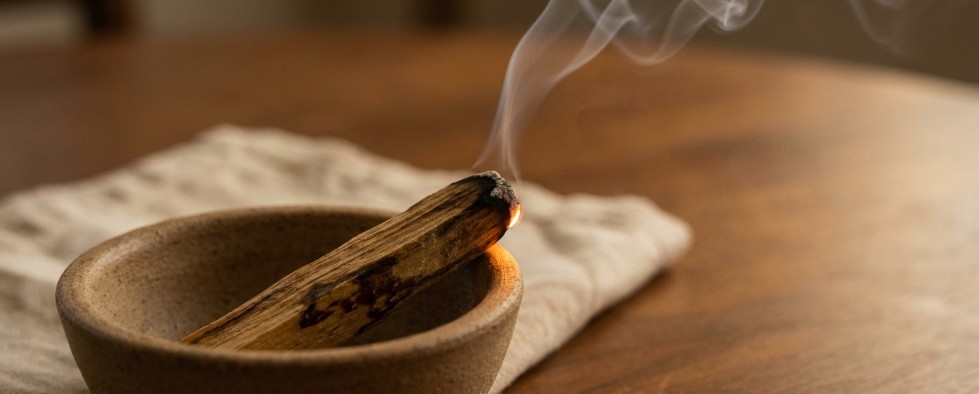
The technique is simple and explainable to anyone in half a minute. But there's an important difference between making it work and making it work well.
-
Hold the stick at an angle in the flame
Take the stick by the unlit end and hold the tip carefully in a candle flame or lighter. Not upright — at roughly a 45-degree angle the wood catches better.
-
Give it twenty to thirty seconds
Let the tip genuinely catch flame. Too short and it goes out the moment you take the flame away. With good wood you can see resin bubbling and hear a faint crackle.
-
Blow it out gently
Pull the stick back, blow the flame out softly, and let it smoulder. Well-dried wood will keep glowing for minutes and release smoke steadily.
-
Set it in a dish
A heat-resistant dish (ceramic, abalone shell, sand bowl) is safer than a flat surface. Ash can drop, and the tip stays hot.
-
Save what's left
A Palo Santo stick is reusable. It dies out on its own, and you can light it again next time — usually four to six uses per stick before it's spent.
A short practical tip: if a stick refuses to relight, it almost always comes down to one of two things. Either the wood has taken on moisture (storage too damp), or the previously burned tip is too far gone into ash. The first asks for a few days drying in a warm dry place. The second asks for scraping the charred tip until you reach fresh wood.
Palo Santo or white sage — when to use which?
Both are traditionally used for cleansing, but they're different plants with different scents and different backgrounds.
| Aspect |
Palo Santo |
White sage |
| Origin |
South American coastal forests |
North America, mainly California |
| Scent |
Sweet, woody, light citrus |
Herbal, sharp, smoky |
| Smoke output |
Light and brief |
Heavy and sustained |
| Burn time |
Smoulders in short rounds |
Burns longer in one go |
| Best for |
Short sessions, daily use |
Full house cleansing ritual |
| Sustainability |
Careful sourcing essential |
Wild-harvested vulnerable; cultivated OK |
For everyday situations — freshening a room after a long day, before meditating, after a conversation that landed heavy — Palo Santo works more comfortably. Shorter, softer, less smoke. For a larger ritual sweeping through the whole house, white sage performs better because its smoke lingers.
Storage and shelf life
Palo Santo is essentially imperishable — the wood has already spent years maturing before it reached your hands. But a few things do affect the scent over time.
- Keep it dry. Moisture is the only real enemy. A sealed glass jar or a tin is ideal. An ordinary kitchen cupboard works fine too, as long as it's not next to the kettle.
- Dark is nice but not critical. Direct sunlight slowly evaporates the essential oils. A drawer is better than a windowsill.
- Away from other scents. Palo Santo absorbs nearby aromas. Don't store it next to coffee, spices or essential oils — the neighbour seeps in.
- Shelf life runs in years. Stored well, the scent stays stable for years. If a stick smells weaker after a long time, lightly scoring the surface with a knife exposes fresh resin.
What suits whom?
Not everyone buys Palo Santo for the same reason. A few common matches:
- Want a pleasant scent and nothing more: classic sticks. Simple, reusable, affordable per session.
- Want something short every evening: incense sticks with Palo Santo. More practical than lighting a stick; one stick of incense burns fifteen to twenty minutes hands-free.
- Want variation within the Palo Santo family: the blends with champa, sandalwood, rose or frankincense shift the scent without losing it.
- Want to go deeper into the ritual: the smudge bundles with Palo Santo and myrrh or other resins, for longer seated sessions.
- Doing shamanic work: loose sticks plus shredded wood for a charcoal disc, so you can match the intensity to the moment.
Why Next Level Smart?
- More than 10 years of experience in ethnobotanical products — not the sudden-trend importer model
- Matured wood from Peru and Ecuador — only from trees gathered in line with local regulations and with respect for the ecosystem
- Full range of forms — pure sticks, shredded, incense, smudge bundles and Sagrada Madre blends, so you can match the form to the occasion
- Discreet shipping across the Netherlands and Europe
Further reading
For anyone wanting to know more about the ritual itself — not just the wood, but what you do with it — our complete smudging ritual guide is the natural next step. For wider context on incense in general: the incense guide walks through the differences between incense types. And for anyone interested in blended Palo Santo: our Sagrada Madre introduction.
Is Palo Santo really holy wood, or is that marketing?
"Holy wood" is the direct translation of the Spanish palo santo. The name comes from a ceremonial tradition in South America where the wood has been used for centuries by indigenous peoples for cleansing, prayer and medicinal rituals. How sacred it feels in your own use is your call. The name itself is not a marketing label.
Is Palo Santo endangered?
Not officially. Bursera graveolens is not on the IUCN list of endangered species. It is, however, under pressure in several regions due to the combination of slow growth, high market demand and illegal cutting of living trees. Ecuador has banned cutting of living trees since 2008; Peru applies strict quotas. Responsible sourcing — only naturally fallen, matured wood — is what separates a product with a future from one without.
How long does a Palo Santo stick burn?
Each lighting usually gives two to five minutes of smouldering. But the stick is reusable. An average stick lasts four to six uses before it's finished. Reckon on about twenty minutes of effective burn time per stick, spread across multiple sessions.
What's the difference between Peruvian and Ecuadorian Palo Santo?
Subtle but real. Peruvian wood tends toward a drier, more citrus-forward profile. Ecuadorian wood often has a rounder, sweeter base. Both come from the same ecosystem (same tree species), but soil, microclimate and specific maturation time can shift the scent profile slightly. Mostly noticeable side by side.
Can I combine Palo Santo with other incense?
Yes, and it often works well. Lighting a Palo Santo stick before a session with other incense (frankincense, sandalwood, copal) sets the tone without overpowering the other scent. The Sagrada Madre blends already do this in one stick.
Is it okay to burn Palo Santo indoors, including in a flat?
Yes, no issue. The smoke output is much lighter than white sage and limited to a few minutes per session. A window cracked open, a heat-resistant dish, and the smoke alarm on alert — that's all it needs. For people with respiratory conditions or pets that react to smoke, normal caution applies.
Why won't my stick burn well?
Almost always one of two things. Either the wood has taken on moisture — leave it a few days in a warm dry place. Or the previously lit tip has gone too far into ash — scrape the charred layer off until you reach fresh wood. Well-dried wood catches flame within twenty seconds and keeps smouldering for minutes.
Is Palo Santo safe around pets?
The smoke is harmless to most animals in small amounts, but cats and dogs have more sensitive airways than humans. Burn it preferably in a room where the animal isn't present, or open a window. Birds and small pets like guinea pigs are especially sensitive; never burn it in a room with birds.
How do you tell good Palo Santo from poor wood by smell?
Three signals. One: weight. Matured wood with resin is noticeably heavier than fresh dry wood. Two: visible resin channels — small shiny streaks at the surface. Three: scent before burning. A stick of matured wood leaves a light scent on your fingers when you pick it up; fresh young sticks smell of almost nothing.
Is Palo Santo essential oil the same?
Chemically similar — both contain the same main components (limonene, α-terpineol) — but the use is different. The oil is concentrated and used mainly in aromatherapy and as a skin oil, not for burning. For the typical ritual and scent use of Palo Santo, the wood itself remains the right form.
Disclaimer: This guide is informational and describes the use of Palo Santo as a ritual and aromatic wood. No medical claims. For respiratory conditions, pregnancy, or use in a room with pets or young children: ventilate well or burn in a separate space. Always place burning or smouldering wood in a heat-resistant dish.
Last updated: June 2026 | Next Level Smart