When Howard Carter opened Tutankhamun's tomb in 1922, he found the young pharaoh covered with a layer of fresh Blue Lotus flowers. It was no accidental decoration. On the tomb floor stood 36 wine jars, their seals naming the vineyard, the harvest year and the winemaker — some marked for funerary use, others for feasts in the afterlife. Three thousand years later, we can analyse exactly what was in those jars. And thanks to Egyptian papyri and modern chemical analyses, we know how lotus wine was made — and why the combination of wine and flower petals does something that tea or tincture cannot.
This guide follows two tracks at once. The archaeological: what have Egyptologists and wine chemists actually found, and what do the Egyptian texts themselves say about preparation? The practical: three reconstruction recipes you can make today with our dried Nymphaea caerulea flowers, plus an explanation of why wine is chemically so well suited as an extraction medium for the active alkaloids in the plant.
If you just want the recipe: jump to "The three recipes". For the full story: read on.
The discovery — what archaeology shows us
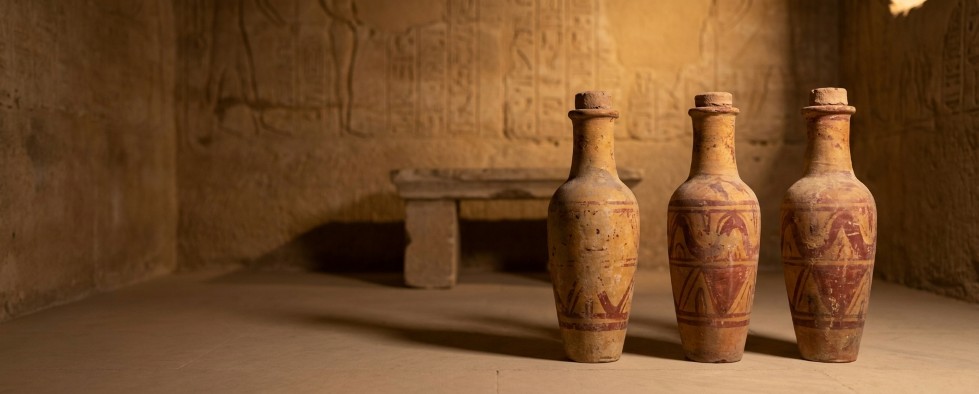
The link between wine and Egypt's sacred flower is not inferred from context — it is literally carved in stone. In the Tutankhamun tomb (c. 1323 BCE) 36 amphora-shaped wine jars were found alongside the mummy. Epigraphic research by Maria Rosa Guasch-Jané (Universidad Pompeu Fabra, Barcelona) showed that the seals distinguished between red and white wine — a distinction not previously suspected in Egyptian texts (Guasch-Jané et al., 2006, Journal of Archaeological Science).
Various tomb walls — not only Tutankhamun's, but also later New Kingdom graves — show banquet scenes where guests hold Blue Lotus flowers, smell them, or press the petals into their wine cups. The plant and the wine were each other's companions at the table and in ritual.
But the strongest evidence comes from chemistry. In 2009, Patrick McGovern (Penn Museum, University of Pennsylvania) and colleagues published the first systematic analysis of wine residues from Egyptian amphorae, using LC-MS and GC-MS techniques. The study identified residues of honey, herbs and resins — and confirmed that Egyptian wines were routinely enriched with botanical ingredients (McGovern et al., 2009, PNAS). The oldest amphora analysed came from the tomb of Scorpion I (c. 3150 BCE) — predating the first dynasty itself. Herbed wine, then, lies at the very root of Egyptian culture.
What the Egyptians themselves say — the papyri
The Egyptian medical papyri are among the oldest systematic descriptions of plant use we have. The Ebers Papyrus (c. 1550 BCE, now in Leipzig) contains over 700 recipes. Several mention seshen — the Egyptian name for Blue Lotus — as an ingredient for internal use, often combined with wine or beer as a solvent. The Edwin Smith Papyrus, primarily a surgical text, mentions the plant in compounds for external and aromatic use.
The recipes are not always easy to decipher — Egyptian measures differ considerably from modern ones, and some ingredients are still not definitively identified. But the constant is clear: seshen was not drunk as a dry tea, but soaked in dense liquids — wine for festive and ritual contexts, beer for daily use. The soaking time varies from several hours to several days.
Several Ebers recipes describe how lotus petals are steeped in jrp (the Egyptian word for wine) for "the time of a night and a day" — well within the extraction window recommended today for alkaloid extraction in alcohol. Despite its age, the Egyptian pharmacopoeia was remarkably methodical in dosing and preparation.
Why wine works — the chemistry of extraction
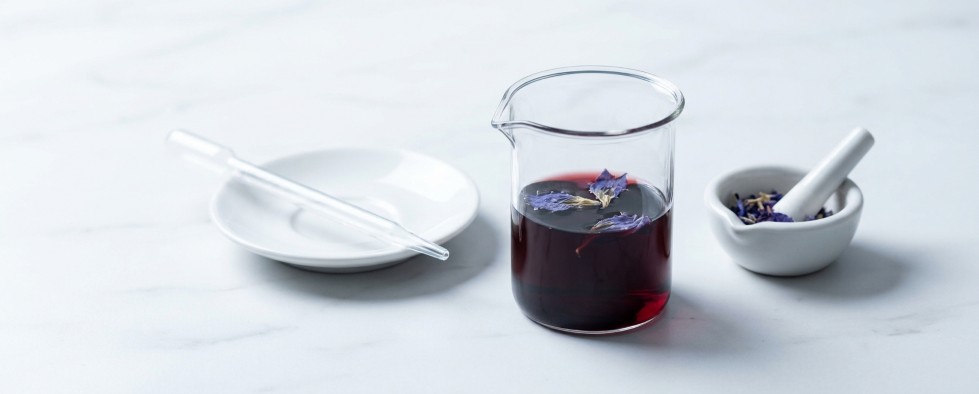
Wine as a solvent for plant alkaloids is no coincidence and no mystery. It is simply good chemistry. The two pharmacologically interesting compounds in Blue Lotus — apomorphine and nuciferine — are aporphine alkaloids that dissolve poorly in water but reasonably well in ethanol. A wine of 12-13% alcohol provides exactly the solvent strength that tea lacks (Poklis et al., 2017).
There is also a second effect. Egyptian wines were usually not pure — they contained honey, dates, resins and other herbs. Some of those ingredients are natural cytochrome P450 inhibitors, meaning they slow the liver's breakdown of plant alkaloids. Whether the Egyptians had figured this out empirically or not — the resulting effect is a longer duration of action than the same dose dissolved in pure alcohol. This partly explains why historical sources speak of "a night and a day" of action at ceremonial doses, while modern tea preparations typically last 2-4 hours.
The alcohol itself also contributes to the experience — not only as a solvent, but as a mild sedative that works alongside the plant alkaloids. A moderate glass of lotus wine feels different from the same plant dose in tea, precisely because the alcohol plays a synergistic role. In modern terms it is a natural entourage: the whole does more than the sum of its parts.
The three reconstructions — recipes for today
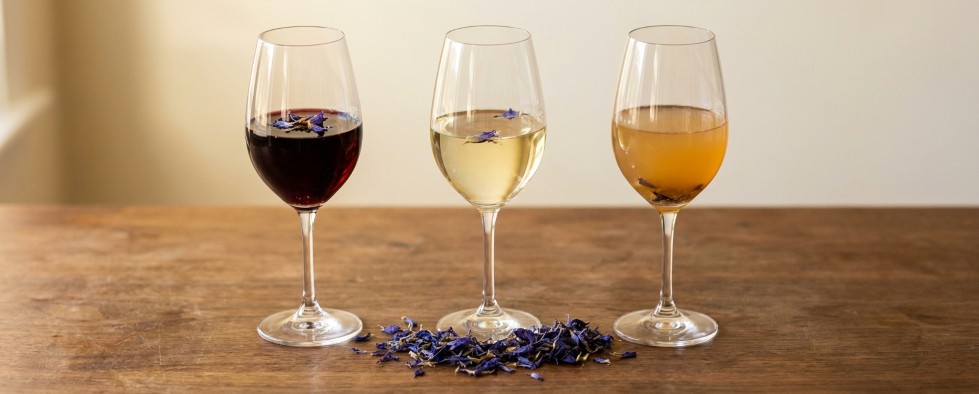
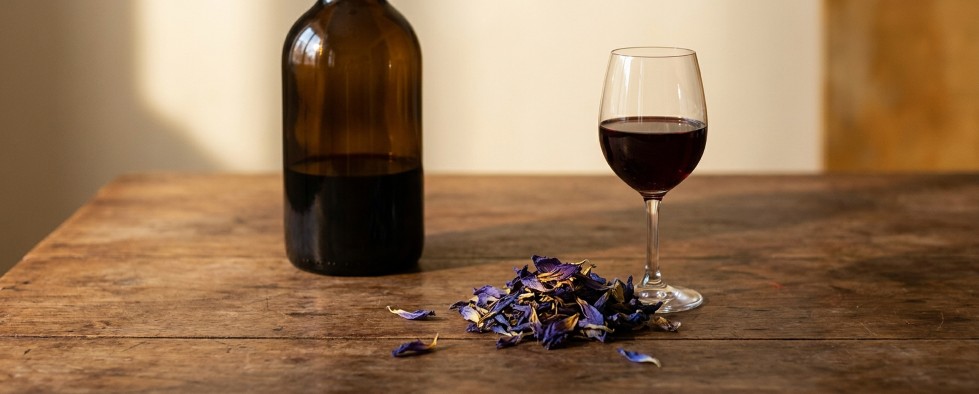
Three variants below, all made with our dried Blue Lotus flowers. The first is the classical recipe, closest to what the Egyptians made. The second is a lighter variant for those who don't drink red wine. The third uses mead (honey wine) — a variant historically present in Egypt as well, and chemically interesting because honey brings additional cytochrome-P450-modulating compounds.
1. Classical red lotus wine — the traditional recipe
This is the preparation closest to the Egyptian original. Works best with a red wine of moderate tannin levels; heavy wine masks the subtle floral notes.
-
Choose the wine
Take a bottle of red wine at moderate alcohol percentage (12-13%). A simple Côtes du Rhône, Chianti or Spanish Garnacha works well. Avoid heavy tannin bombs and strongly aged wines.
-
Add the flowers
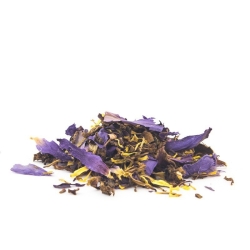
Add 5 to 10 grams of dried Blue Lotus petals per 750 ml bottle. Start at 5 grams for a first batch and adjust to taste.
-
Let it infuse
Close the bottle and store in a dark, cool place for 1 to 2 weeks. Shake gently once a day to distribute the petals through the wine.
-
Strain and serve
Strain out the petals through a fine tea filter. Re-bottle in a dark bottle if you like. The wine keeps for 2 to 3 months in cool storage.
Taste: a red wine with a light floral undertone and noticeable warmth. The plant alkaloids produce a calm, contemplative mood after a glass or two — stronger than the same amount of tea.
2. White variant — for those who don't drink red
For those wanting a lighter experience or who don't enjoy red wine, a dry white works just as well. Bonus: the floral aroma often comes through more clearly in white.
- Take a dry white wine of 12-13% (Sauvignon Blanc, Pinot Grigio or Albariño all work well)
- Add 5 to 8 grams of dried petals per 750 ml bottle
- Infuse for 1 week in the refrigerator (white wine keeps fresher at low temperature)
- Strain and serve well chilled
The experience is slightly subtler than the red variant — less warm, lighter, better suited to an early-evening ritual.
3. Mead variant — the historical honey route
Mead (honey wine) was drunk in ancient Egypt alongside grape wine and is chemically interesting because honey brings flavonoids that affect the action of plant alkaloids. The mead recipe is more intense in flavour and lighter in alcohol.
- Take a dry mead of 10-12% alcohol (not a sweet dessert mead)
- Add 6 to 8 grams of dried petals per 500-750 ml bottle
- Infuse for 10 to 14 days at room temperature, shaking gently each day
- Strain. Mead-lotus is best drunk at room temperature, not chilled
The experience: a rich, honey-floral variant with a rounder mouthfeel. For some users, the most clearly felt effect of the three — likely due to the combination of honey flavonoids and lotus alkaloids.
Ritual and serving — modern use
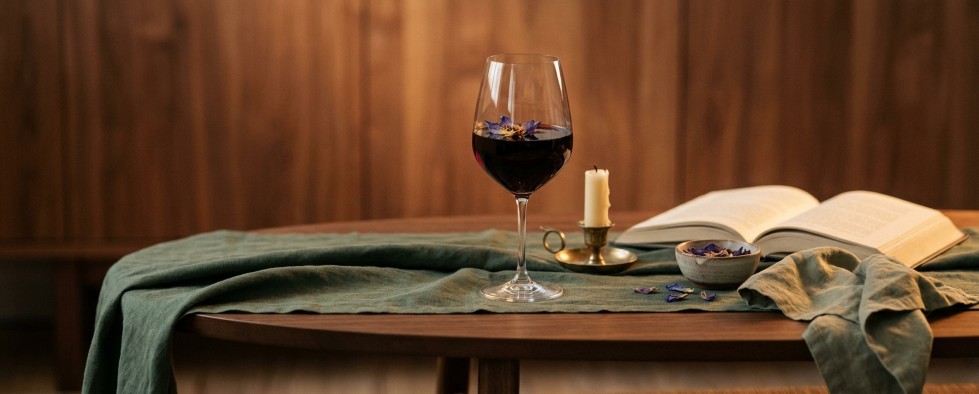
Lotus wine, unlike tea, is a drink suited to a social-ceremonial moment. A few considerations for modern use.
When lotus wine fits
- A quiet dinner with a partner or friend — replaces a regular glass of wine and gives a deeper, calmer tone to the conversation
- A personal evening ritual — one glass 30 to 45 minutes before sleep, instead of or after a light meal
- A ceremonial opening — for those working with intention, dreams or a cacao ceremony, half a glass of lotus wine makes a fine chemical bridge between everyday and ritual
- A literary or contemplative evening — reading, writing, listening to music by candlelight, with a glass in hand
Dosing guidance
With a well-prepared bottle, one glass (about 125 to 150 ml) is enough for most people to feel a noticeable effect. Two glasses feels like the sweet spot for many — more brings the general wine effects to the fore without strengthening the plant action. Three or more glasses tends not to feel pleasant.
For those who prefer to microdose: a tablespoon (15 ml) taken sublingually about half an hour before sleep gives a milder but still noticeable effect — comparable to a few drops of tincture, but with a different experiential colour.
Safe use — alcohol and plants
Lotus wine combines two mildly sedating actions: the plant's and the alcohol's. That strengthens the effect but also calls for attention.
- Start with one glass on your first batch. Feel how your body responds before building up.
- Do not combine with strongly sedating drugs (sleeping pills, benzodiazepines, opioids). The effects stack unsafely.
- Do not combine with Parkinson's medication (dopamine agonists, MAO inhibitors) without consulting a doctor; apomorphine in the plant may theoretically interact.
- Avoid during pregnancy or breastfeeding — both the alcohol and the plant rule out use during these periods.
- Do not drive after intake, even at microdose levels.
- Storage: in a sealed dark bottle in the refrigerator, maximum 2 to 3 months. The flower alkaloids are sensitive to light and oxygen.
Why Next Level Smart?
- More than 10 years of experience with ethnobotanical products and their use
- Our dried Blue Lotus flowers come from controlled cultivation and are lab-tested for heavy metals and pesticides
- Discreet shipping across the Netherlands and throughout Europe
- Full Blue Lotus cluster — pillar guide, Kanna comparison and this wine guide woven into a single information source
Read further
Want a deeper botanical and historical background? Read our complete Blue Lotus pillar guide. Hesitating between Blue Lotus and Kanna for your evening ritual? See the comparison guide.
Frequently asked questions about Egyptian lotus wine
Which wine works best for lotus wine?
A red wine of moderate tannin and 12 to 13% alcohol. Heavy wines overpower the subtle floral undertone. A simple Côtes du Rhône, Spanish Garnacha or Italian Chianti works well. For the white variant: a dry Sauvignon Blanc or Pinot Grigio.
How much Blue Lotus do you need per bottle?
5 to 10 grams of dried petals per 750 ml bottle. Start at 5 grams for a first batch — you can always build up, but over-infusing makes the wine bitter. One pouch of our dried Blue Lotus flowers is good for 5 to 10 batches.
How long should the wine infuse?
At least 1 week for a noticeable effect, ideally 10 to 14 days. The alkaloids dissolve gradually into the alcohol. Less than a week produces a wine with aroma but little pharmacological action; longer than two weeks intensifies the taste without strengthening the effect proportionally.
Why does wine work better than tea for Blue Lotus?
The active alkaloids apomorphine and nuciferine dissolve poorly in water and reasonably well in alcohol. A wine of 12 to 13% provides the right solvent strength. In addition, historical Egyptian wines contained other ingredients (honey, resins) that slow the breakdown of the alkaloids — producing a longer duration of action than tea.
Can you make lotus wine with other flowers or herbs?
Yes, for flavour variation. A pinch of vanilla, a few cloves or a sprig of fresh chamomile alongside the Blue Lotus gives the wine a richer, more complex bouquet. However: do not add other pharmacologically active plants (kanna, mulungu) without first testing how you respond to each plant on its own.
How long does lotus wine keep?
After straining: 2 to 3 months in a sealed dark bottle in the refrigerator. The alkaloids are sensitive to light and oxygen; warm or sun-exposed storage gradually breaks them down. A wine that turns cloudy or bitter has gone past its shelf life.
Is lotus wine stronger than tea?
Yes, noticeably so for most people. Through better alkaloid extraction in alcohol plus the synergistic effect of the wine itself, one glass is comparable to roughly two cups of strong Blue Lotus tea. Start low — one glass is enough to learn the effect.
Can I use mead instead of grape wine?
Yes, and it's historically authentic. Mead (honey wine) was drunk in ancient Egypt alongside grape wine. Use dry mead of 10 to 12% alcohol, not a sweet dessert mead. Honey brings flavonoids that deepen the experiential effect — for some users, mead-lotus produces the most pronounced action of the three variants.
Why did the Egyptians add flowers to wine?
For ritual and for effect. Seshen (the Egyptian name for Blue Lotus) was the symbol of rebirth. Adding it to banquet wine was both an offering and a way of sharing in the spiritual action. But the chemistry did not lie: the combination of alkaloids and alcohol gave banquets a deeper experience than wine alone.
Is lotus wine safe to drink while on medication?
When using SSRIs, MAO inhibitors or Parkinson's medication: not without consulting your doctor. Apomorphine in the plant may theoretically interact with these drug classes. For other medication: bear in mind that lotus wine contains alcohol, so the same caution applies that holds for wine in general. When in doubt: ask the pharmacy before pouring your first glass.
Disclaimer: This guide is purely educational and discusses traditional and contemporary use of Blue Lotus (Nymphaea caerulea) in wine preparations. The information is not medical or health advice and is intended for adults. Drink in moderation. Consult a doctor or pharmacist if using medication, during pregnancy or with existing health concerns.
Last update: June 2026 | Next Level Smart