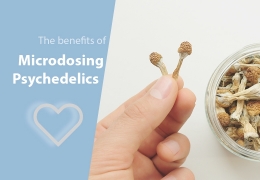
Microdosing with psychedelics has, in the space of a decade, grown from a Silicon Valley curiosity into a serious subject in both research and the smartshop. In the Netherlands you have two legal routes if you want to start yourself: magic truffles, bought ready-to-use, or magic mushrooms you grow yourself from a kit. Both work on the same compounds, but the practical approach is fundamentally different.
Most information online is about truffles — they are, after all, the most directly available form in the Netherlands. Magic mushrooms get noticeably less attention, even though for anyone willing to grow their own they offer a compelling alternative: a personal supply, a far longer shelf life, and — done well — a more precisely dose-able product.
This guide walks through the whole picture: where mushrooms differ meaningfully from truffles, which strains lend themselves to microdosing, how to arrive at a reliable dose, which protocols exist, and what the science says about all of it.
The main difference: mushrooms are roughly ten times stronger
Fresh magic truffles contain around 0.5 to 1 percent psilocybin and psilocin by weight. Dried magic mushrooms sit between 0.5 and 1.2 percent — but that's against the dry weight, which is roughly a tenth of the fresh weight. The net effect: one gram of dried Psilocybe cubensis contains about as much active compound as eight to twelve grams of fresh truffle.
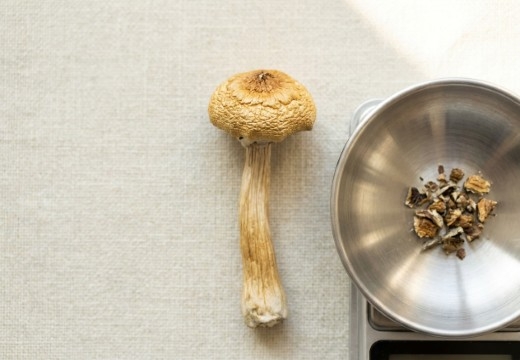
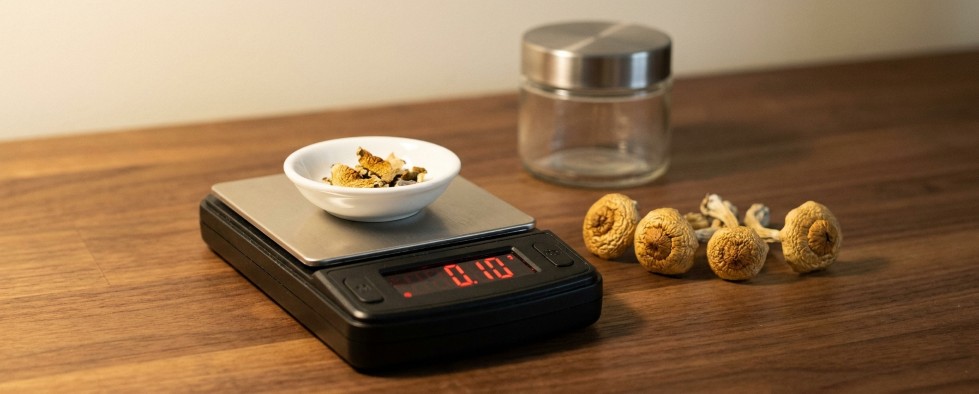
For anyone microdosing this means one thing: dosing with dried mushrooms calls for far more precision. Where a truffle microdose lies somewhere between 0.5 and 1 gram fresh, a mushroom microdose sits between 0.05 and 0.15 gram dry. Fifty to a hundred and fifty milligrams, in other words — an amount you can no longer reliably estimate by eye. A precision scale is not a luxury here but a necessity.
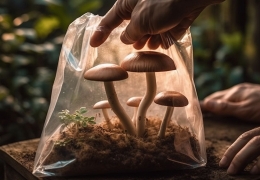
There is a second practical difference. Truffles come fresh, in a vacuum pouch, ready to use. A batch of fresh mushrooms has to be dried thoroughly first and then stored correctly, or the potency drops within weeks and every dose becomes a guess. That changes the whole approach: with truffles you think in single sessions; with mushrooms you think in cycles of grow-dry-dose-store.
Which mushroom strain to choose?
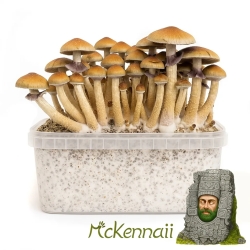
For microdosing the gentler Psilocybe cubensis varieties work best. They are moderately potent, fairly stable in alkaloid profile and grow predictably from a standard kit.
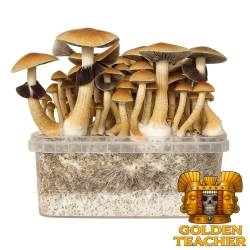
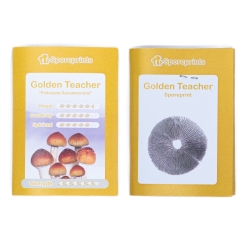
- Golden Teacher — the classic. Friendly effect profile, predictable yield, easy to find spores for repeat grows.
- Mexican — slightly milder than Golden Teacher, often the first choice for anyone new to growing.
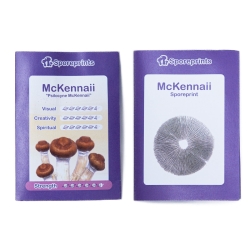
- McKennaii — slightly stronger, suited to anyone who already knows how it works and prefers smaller dose sizes.
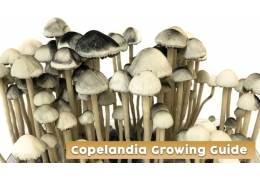
Not for microdosing: Copelandia / Hawaiian (Panaeolus cyanescens). This species contains five to ten times more psilocybin per gram than cubensis. Dosing then becomes a matter of tens of milligrams — beyond what is reliably weighable at home. A great mushroom for anyone looking for a full trip, unsuitable for anyone wanting to dose subtly.
A reliable supply as the foundation
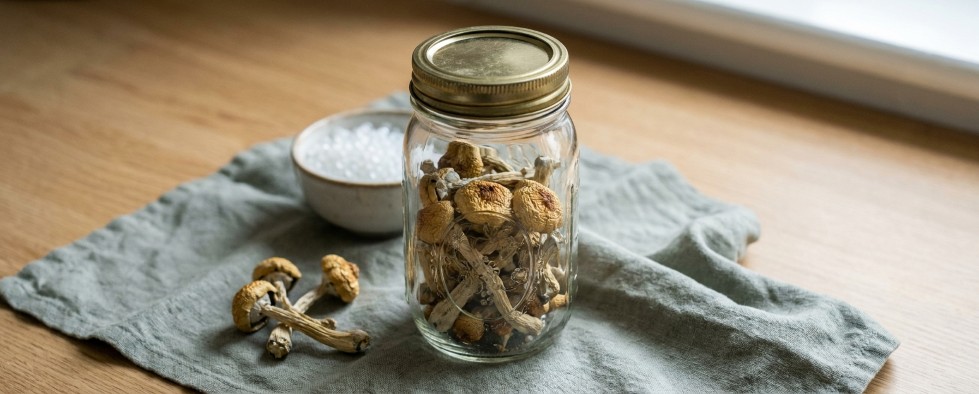
Microdosing stands or falls on the predictability of your dose. At a full dose, five to ten percent variation in potency barely matters — you'll feel a clear effect either way. But at a microdose of 0.1 gram, that same variation is exactly the difference between sub-perceptual and clearly felt. Your supply therefore needs to be stable, batch after batch, week after week.
That starts with proper drying and storage. A mushroom that isn't dry enough loses a meaningful share of its action within weeks — and then the 0.1 gram of today does something different than the 0.1 gram of last month. The difference between a reliable and an unreliable microdose schedule sits precisely in this detail: a well-dried, airtight stored supply holds its potency comfortably long enough to dose consistently across a whole cycle.
For the practical steps — drying, storage, shelf life, vacuum sealing — our mushroom storage guide covers everything in detail. For the growing side, the grow kit guide and the grow kit FAQ walk through every step.
Figuring out your dose
For sub-perceptual microdosing with dried Psilocybe cubensis, most user reports fall in the 0.05 to 0.15 gram per dose range. That's before personal sensitivity, weight and tolerance build-up come in. The common approach:
- First dose: 0.05 gram (50 mg) — below threshold for most people. The point is only to gauge your sensitivity.
- Second and third dose (in the next cycle): 0.1 gram (100 mg) — for many the sweet spot for sub-perceptual microdosing.
- Above 0.15 gram — no longer sub-perceptual for most people. You feel something happening. Some users like that (a slight mood lift), others find it too far.
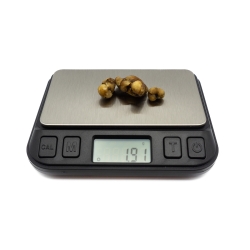
For these amounts you need a precision scale with 0.01 g resolution. A kitchen scale with 1-gram resolution falls short here — it rounds your dose to the wrong gram. The most accurate approach is to crumble your dried mushrooms finely first and then weigh per dose. Anyone who would rather not weigh weekly can fill an entire batch into capsules of 0.1 gram each — a whole cycle ready to go.
For anyone wanting to skip the maths, our magic mushroom dosage calculator takes your body weight and intended dose level and returns a recommendation, including microdose ranges.
Protocols: Fadiman, Stamets and what the science says
The microdosing field has two widely followed protocols, both originally formulated by familiar names in the psychedelics world.
The Fadiman protocol
The classic, designed by psychologist James Fadiman: one dosing day, two rest days. So day 1 a microdose, days 2 and 3 nothing, day 4 another microdose. A cycle runs for 4 to 8 weeks and is followed by a break of at least two weeks to let tolerance drop back. The thinking behind it: on rest days you still feel the lingering effect without building tolerance.
The Stamets Stack
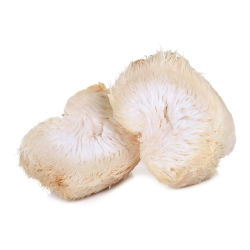
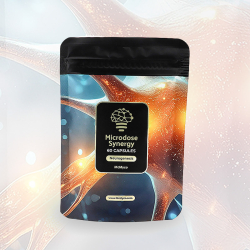
Mycologist Paul Stamets proposed combining a microdose of psilocybin with Lion's Mane extract and a low dose of niacin (vitamin B3). The hypothesis: Lion's Mane supports neurogenesis; niacin briefly improves blood-brain barrier passage for active compounds through short-term vasodilation. The schedule is four dosing days in a row, then three rest days, for 4 weeks, then a break. For anyone who would rather take the full combination ready-made instead of assembling it themselves, we stock Microdose Synergy Capsules with Lion's Mane.
What the science says so far
Research into microdosing has, in a decade, grown from a marginal subject into a serious field. A large survey by Polito and Stevenson (2019, PLOS ONE) showed clear self-reported improvements in mood, creativity and focus among regular microdosers. Anderson and colleagues (2019, Harm Reduction Journal) documented a broad range of reported effects in a large international sample — predominantly positive.
Recent placebo-controlled work — such as Szigeti and colleagues (2021, eLife) — indicates that expectation and ritual contribute measurably to the perceived effect. That is true of almost any ritual practice and says little about the value of the protocol on its own; it does point out that the approach — fixed moments, deliberate intention, careful dosing — is part of what makes it work. Clinical research into specific microdosing protocols is underway at several research centres worldwide; the picture is becoming clearer year by year.
What to expect (and what NOT to)
With a well-dosed microdose, you mostly should not feel different. That is not a shortcoming — that is the point. Sub-perceptual means: no perceptible trip, no visual effects, no disruption of your working day. Users do often report after a few cycles:
- A lighter, more open feeling without being "high"
- Improved mood on heavy days
- More creative association in work that calls for cognitive flexibility
- Slightly easier to fall asleep on dosing days
What you don't expect: visual effects, sudden revelations or a dramatic personality change. Microdosing isn't a switch you flip — it's a subtle addition that, for many, slots naturally into a busy week. Most people find their own rhythm within the first two cycles: which strain, which dose and which protocol fit their body and their schedule.
Safety, tolerance and when not to microdose
Psilocybin has a well-documented safety profile in responsible use, but microdosing comes with several serious contraindications.
When microdosing is not appropriate
- When taking SSRIs, SNRIs or MAO inhibitors — serotonergic interaction is theoretical but real. Consult your doctor; do not stop medication without supervision.
- With personal or family history of psychosis, schizophrenia or bipolar disorder — psilocybin can trigger latent symptoms. Hard "no".
- During pregnancy or breastfeeding — insufficient research.
- With serious heart conditions — psilocybin produces a mild rise in heart rate and blood pressure.
- Under 21 years old — the brain is still developing and long-term research is lacking.
Tolerance and breaks
Psilocybin builds tolerance fast. Without breaks the same weight will barely do anything after a few weeks — a sign your system has adapted. Building in breaks (one to two weeks after each cycle of 4 to 8 weeks) is essential to stay effective and to avoid cross-tolerance with other serotonergic compounds.
Don't drive, don't operate machinery
Even at sub-perceptual doses: avoid driving and machine work in the first hours after intake. You may not feel much yourself, but reaction times can be subtly extended.
Comparison with truffle microdosing in one table
| Aspect |
Magic Mushrooms (dry) |
Magic Truffles (fresh) |
| Source |
Grown yourself from a kit |
Ready-to-use from a smartshop |
| Typical microdose |
0.05 - 0.15 gram |
0.5 - 1 gram |
| Precision scale |
Required (0.01 g) |
Recommended (0.1 g) |
| Preparation per batch |
Grow, dry, store — weeks |
Open the pouch |
| Shelf life |
Months to a year (if dry) |
Weeks (chilled) in vacuum |
| Onset |
30 - 60 minutes |
20 - 45 minutes |
| Best for |
Those wanting to grow themselves and build a long supply |
Those wanting to start straight away without a grow phase |
For those preferring the truffle path: read our truffle microdosing guide with protocols and dosing specifically for sclerotia.
Why Next Level Smart?
- More than 10 years of experience with magic mushroom grow kits and the cycle around them
- Three cubensis varieties in stock all suited to microdosing — Golden Teacher, Mexican, McKennaii
- Complete ecosystem — grow kits, spore prints for follow-up grows, Lion's Mane for the Stamets stack, precision scales
- Lab-tested where possible, careful inventory storage
- Discreet shipping across the Netherlands and Europe
Read further
New to magic mushrooms? Read our grow guide and the extensive grow kit FAQ first. Prefer truffles? See our magic truffles pillar and the specific truffle microdosing protocol. And for anyone wanting to store the supply correctly: the mushroom storage guide.
What exactly is a magic mushroom microdose?
A quantity of dried mushroom small enough that you do not feel a psychedelic effect — typically between 0.05 and 0.15 gram dry. The aim is sub-perceptual: no trip, no visual effects, only subtle influence on mood, creativity or focus.
What is the difference between mushroom microdosing and truffle microdosing?
Mostly potency. Dried mushrooms are roughly eight to twelve times stronger per gram than fresh truffles. A mushroom microdose sits around 0.1 gram, a truffle microdose around 0.5 to 1 gram. Practically that means for mushrooms you need a precision scale with 0.01 gram resolution, and you have to grow and dry the supply yourself. Otherwise the mechanism is the same.
Which mushroom strain is best for microdosing?
Psilocybe cubensis varieties are the most suitable: moderately potent, predictable, easy to grow. Golden Teacher is the classic first choice. Avoid Copelandia / Hawaiian Panaeolus for microdosing — that species is five to ten times stronger and therefore hard to dose accurately.
How do you weigh 0.1 gram accurately?
With a digital precision scale with 0.01 gram resolution. Our On Balance Truweigh 200 g is made for this. Crumble the dried mushroom fine, place a small dish on the scale, tare to zero, and weigh your dose. A 1-gram resolution kitchen scale is not adequate here.
How long does a microdose last?
The acute effect itself sets in within 30 to 60 minutes and lasts 4 to 6 hours. But many microdosers report a noticeable "after-effect" on rest days too — a background influence the Fadiman and Stamets protocols try to leverage with their rhythm of dosing and rest days.
What is the Stamets Stack?
A protocol from Paul Stamets: a microdose of psilocybin combined with Lion's Mane extract and a low dose of niacin (vitamin B3). Four dosing days in a row, three rest days, repeat for four weeks, then a break. The hypothesis: Lion's Mane supports neurogenesis; niacin briefly improves blood-brain barrier passage. We also stock Microdose Synergy Capsules with Lion's Mane for anyone wanting to follow the stack fully.
How well supported is microdosing scientifically?
The research is still in an early phase, but the foundation is growing fast. Large self-report studies (Polito and Stevenson 2019, Anderson and colleagues 2019) show predominantly positive effects on mood, creativity and focus. Placebo-controlled work shows that the ritual side of the protocol — fixed moments, deliberate intention, careful dosing — plays a real role in how it works. Clinical research into specific protocols is underway; the picture will sharpen over the coming years.
How long can you keep up a microdosing cycle?
Four to eight weeks at a stretch, followed by a break of at least two weeks. Then a new cycle can start. Without breaks you build tolerance and the effect drops off quickly. Many users do two to three cycles per year rather than running continuously.
When should you not microdose?
When taking SSRIs, SNRIs or MAO inhibitors; with personal or family history of psychosis, schizophrenia or bipolar disorder; during pregnancy or breastfeeding; with serious heart conditions; and under 21 years old. When in doubt: ask your doctor. The family psychosis history is the most important — that is a hard "no", not a "be careful".
How do you store dried mushrooms for microdosing?
Properly dried, in an airtight dark container or vacuum bag, in a cool dry place. In the freezer they can hold their potency for a year or longer. For the full storage instructions and shelf-life details: see our mushroom storage guide.
Disclaimer: This guide is purely educational and intended for adults making independent decisions about plant use. The information is not medical advice. Psilocybin falls under the Dutch Opium Act when present in dried mushrooms; grow kits themselves are legal to purchase for home cultivation. Consult a doctor or pharmacist if using medication, during pregnancy, or with existing health concerns. Do not microdose without carefully considering your situation first.
Last update: June 2026 | Next Level Smart