Last updated: April 2026
This guide is regularly refreshed with new scholarly work on psychedelic history and mycology.
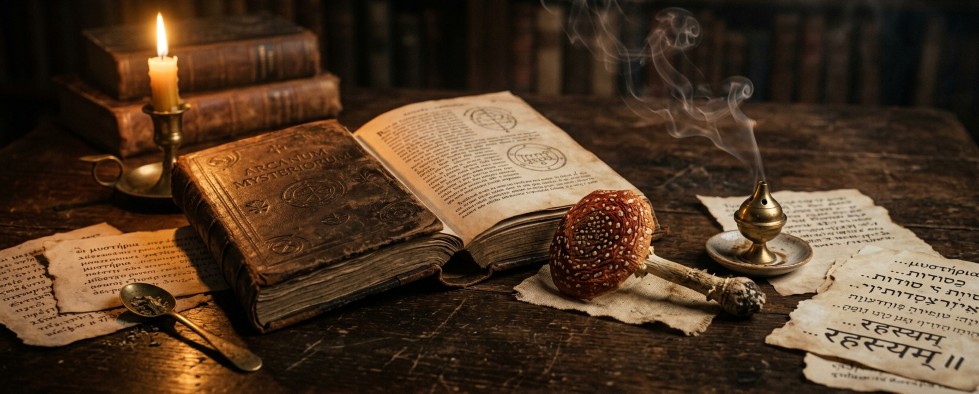
The claim sounds absurd: Jesus wasn't a man, he was a mushroom. Yet that's exactly what Dead Sea Scrolls scholar John Allegro published in 1970, with a reputable British publisher. His academic career didn't survive it. The theory did — and Allegro is far from the only one to link psilocybin and Amanita to the story of Western civilisation.
Magic mushrooms attract myths like almost no other plant. They appear in theories about Jesus, Santa Claus, Greek mystery religions, Vedic ritual, even the evolution of the human brain. Some of these ideas have real scholarly weight behind them. Others collapse the moment you check the footnotes. Time to walk through six of the most famous and see what holds up.
At Next Level Smart, we've been working with magic truffles and grow kits for more than 10 years, and we hear these stories from curious customers all the time. Better to tell the honest version than let the folklore keep growing unchecked.
Why mushrooms attract so many myths
There's something about psilocybin mushrooms that lends itself to legend. They appear suddenly after rain, can't be reliably cultivated in the wild, and rewire your perception for hours. That's fertile ground for mythology.
Many of these theories were also born in a very specific moment. R. Gordon Wasson visited the Mazatec curandera María Sabina in 1955; his 1957 Life magazine article opened the door to the Western world. What followed was a wave of mid-century scholars who started seeing mushroom traces everywhere — in the Bible, in the Vedas, in Greek ritual. Serious research and enthusiastic speculation got mixed together. That's where most of the myths below were born.
For a proper overview of the real, documented history, we recommend our 10,000-year history of magic mushrooms. What follows below is different: a look at the stories that travel on the edge of that history, and how much of each one is actually true.
Myth 1: Jesus was a magic mushroom
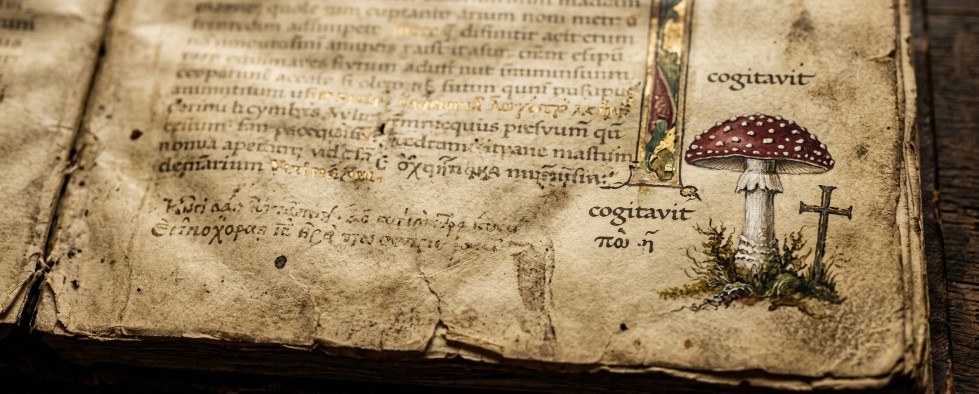
The claim: Early Christianity was a cover story for a secret psychedelic fertility cult built around the fly agaric (Amanita muscaria). Jesus himself was not a historical person but a cryptic name for the mushroom — the sacrament, not the saviour.
Where it came from: John Marco Allegro, a Dead Sea Scrolls scholar at Oxford, published The Sacred Mushroom and the Cross in 1970. Allegro had genuine academic credentials — he was on the original Dead Sea Scrolls editorial team — which is why the book landed with a thud rather than as pure pulp. His argument: if you trace Hebrew, Aramaic and Greek words back to Sumerian roots, a pattern of mushroom-fertility symbolism emerges. The Bible, in his reading, is coded mushroom lore.
What the evidence says: Almost nothing holds up. The book was savaged immediately by philologists. Historian Henry Chadwick wrote in the Daily Telegraph that there was "no particle of evidence for all this exciting conjecture." Religious studies scholar Philip Jenkins has called it "possibly the single most ludicrous book on Jesus scholarship by a qualified academic." Allegro's method — chaining phonetic similarities across unrelated languages — isn't how historical linguistics works. There's also no archaeological trace linking early Christianity to Amanita muscaria, and Amanita isn't even a psilocybin mushroom: its primary active compound is muscimol, a deliriant, not a classic psychedelic.
A more defensible version of "psychedelic origins of Christianity" is argued by Brian Muraresku in The Immortality Key (2020), pointing at ergot and psychoactive wines in the wider Greco-Roman world. That's a different debate, and one we'll touch on in myth 3. Allegro's specific Jesus-as-mushroom thesis is a dead end.
Verdict: Debunked. Beloved by psychedelic culture, rejected by virtually every specialist who has looked at it.
Myth 2: Soma in the Rig Veda was Amanita muscaria
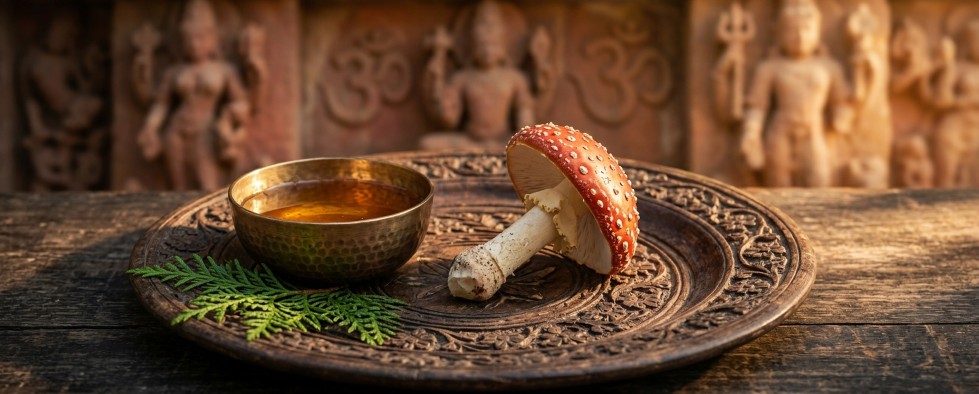
The claim: Soma, the divine plant that ancient Vedic priests pressed, strained and drank for visions and immortality, was the red-and-white fly agaric mushroom, Amanita muscaria.
Where it came from: R. Gordon Wasson's 1968 book Soma: Divine Mushroom of Immortality. Wasson was an amateur mycologist and a Wall Street banker turned psychedelic pioneer (the same man who brought María Sabina's mushrooms to the West). His Soma theory drew on Vedic hymns that describe the plant as having no roots, no leaves and no flowers, and that mention "the urine of men who have drunk Soma" still being potent — a peculiar property that Amanita muscaria genuinely has, because its active compound muscimol is excreted largely unchanged.
What the evidence says: Wasson's case is clever but contested. The Rig Veda describes Soma as growing in the mountains and being bright yellow or tawny; Amanita's classic red-and-white colouring doesn't obviously match. Siberian shamanic use of Amanita is well documented, but a Vedic-era Indian distribution is harder to prove. Over the decades scholars have proposed a long list of alternative candidates: Ephedra sinica (a stimulant plant still called soma by Zoroastrians), Peganum harmala (Syrian rue — an MAO inhibitor), Nelumbo nucifera (lotus), cannabis, and psilocybin mushrooms. Indologist Matthew Clark's 2019 book The Tawny One argues for a Peganum harmala plus DMT-containing plant combination — essentially an early ayahuasca analogue.
The honest scholarly position: we don't know what Soma was. Amanita is one reasonable guess, not the answer.
Verdict: Speculative. A serious hypothesis among several. Treat "Soma was definitely Amanita" with a raised eyebrow.
Myth 3: The Eleusinian Mysteries used a psychedelic drink
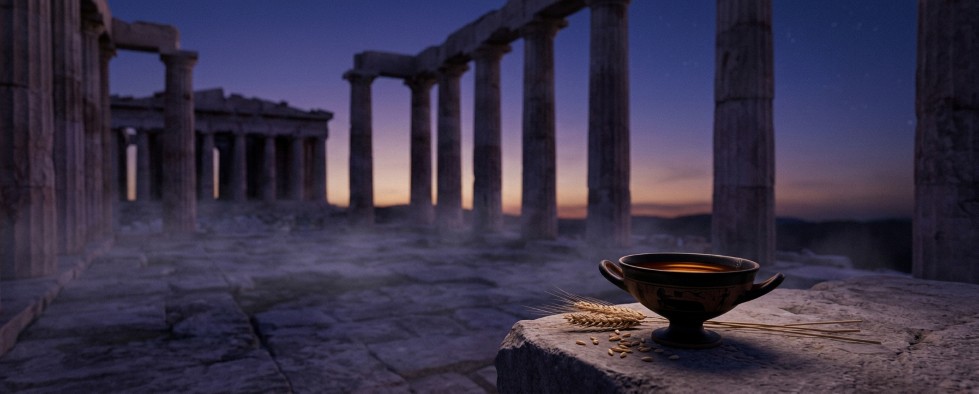
The claim: For nearly 2,000 years, tens of thousands of ancient Greeks — Plato, Sophocles, Pindar, Roman emperors — participated in a secret annual ritual at Eleusis, near Athens, that culminated in drinking a potion called kykeon. The claim: kykeon was psychedelic, almost certainly containing ergot alkaloids (from which LSD was later synthesised).
Where it came from: The Road to Eleusis (1978), a book co-authored by Gordon Wasson, Albert Hofmann (the chemist who discovered LSD), and classicist Carl Ruck. Their argument: ergot, a fungus that grows on barley, naturally contains water-soluble psychoactive alkaloids (ergonovine, lysergic acid amide). The main non-psychoactive ergot toxins that cause ergotism ("St. Anthony's Fire") aren't water-soluble, so a careful water extraction could, in theory, produce a safe psychedelic drink from barley ergot. The Eleusinian kykeon was made from barley. Participants consistently described profound, life-changing visions. The ingredients and the effects line up.
What the evidence says: This is the strongest myth on the list. Independent support has come from unexpected places. In 2020, archaeobotanists analysing residue in ritual vessels from a separate Greek sanctuary at Mas Castellar de Pontós (Catalonia) reported finding evidence of ergot-infected beer consumption in a ceremonial context — the first hard chemical evidence that ancient Mediterranean ritualists did drink ergot-based brews. Brian Muraresku's The Immortality Key (2020) popularised and extended the argument, though some of his broader claims about Christian continuity have been criticised.
The case isn't closed — we don't have kykeon residue, and alternative explanations (intense fasting, sleep deprivation, group suggestion, hallucinogenic fungi on barley rather than ergot specifically) remain on the table. But "ancient Greeks drank something psychoactive at Eleusis" is no longer fringe speculation. It's a mainstream hypothesis with chemical, textual and archaeological support.
Verdict: Plausible, and getting stronger. The best-supported myth on this list.
Myth 4: Santa Claus was a Siberian shaman
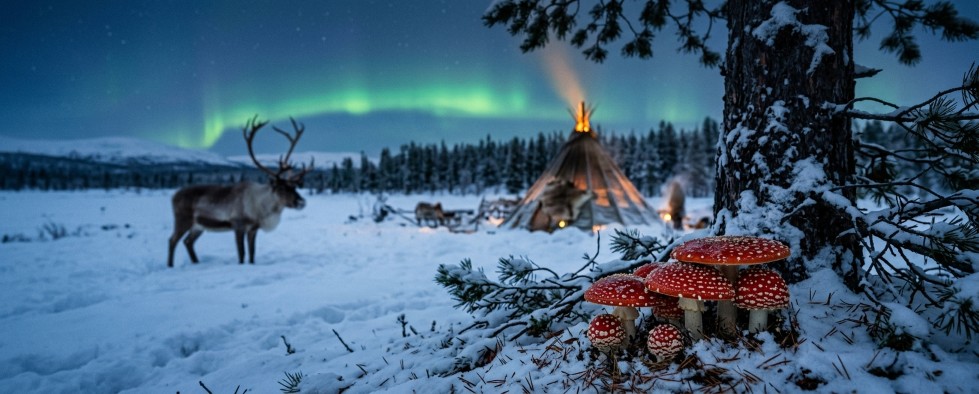
The claim: The red-and-white Santa we know today descends from Siberian Koryak and Evenki shamans who harvested Amanita muscaria mushrooms around the winter solstice, dried them near the fire, and distributed them as gifts. The reindeer, the sleigh, the chimney, the colour scheme — all of it, according to this theory, are fossils of a shamanic tradition.
What the evidence says: Parts of this are genuinely documented. Siberian shamans did use Amanita muscaria. Reindeer really do seek out and eat the mushroom, and their metabolism breaks muscimol down in a way that made the reindeer-urine route a traditional method of consumption (yes, really). Yurts and chums are entered via an opening in the roof when snow blocks the door. The red-and-white fly agaric grows under pine trees. These connections are real.
But the leap from "there are parallels" to "Santa evolved from this tradition" is much weaker. The modern Santa figure is a Victorian-American invention — Clement Clarke Moore's 1823 poem, the 1881 Thomas Nast illustrations, Coca-Cola's 1930s commercial art. His deeper roots are in Saint Nicholas of Myra (4th-century Anatolia) and Dutch Sinterklaas, not in Siberia. Most folklorists treat the Siberian-shaman origin story as a compelling coincidence, not a proven lineage.
We've written a dedicated deep-dive on this one, including the specific parallels and where each one stands: Does Santa have anything to do with magic mushrooms?
Verdict: Partially supported. The Siberian shamanic practices are real; the direct line to modern Santa is circumstantial.
Myth 5: The Stoned Ape theory explains human evolution
The claim: Around 100,000 years ago, early hominids in the African savannah started eating Psilocybe cubensis mushrooms growing on grazer dung. Small doses improved visual acuity and hunting. Larger doses boosted language, imagination, sexuality and religious feeling. This — not climate, not diet, not tool use — is what pushed Homo erectus into Homo sapiens. Mushrooms made us human.
Where it came from: Terence McKenna's 1992 book Food of the Gods. McKenna was a brilliant, quotable ethnobotanist and one of psychedelic culture's favourite thinkers. We covered him properly in our Terence McKenna profile.
What the evidence says: Essentially nothing. Psilocybin doesn't measurably improve visual acuity — several studies suggest it tends to reduce it. There's no paleoanthropological evidence tying hominid cognitive leaps to psilocybin consumption. McKenna was a poet, not a paleoanthropologist, and his references to the scientific literature are thin. The timeline (100,000 years ago) also doesn't match the much older cognitive changes in the Homo lineage.
It's a beautiful, romantic idea. It's also not science. McKenna himself, to his credit, often framed it as a provocation rather than a finished theory.
Verdict: Pseudoscience, treated as poetry. Enjoy it. Don't cite it in a biology paper.
Myth 6: Alice in Wonderland is a psychedelic trip report
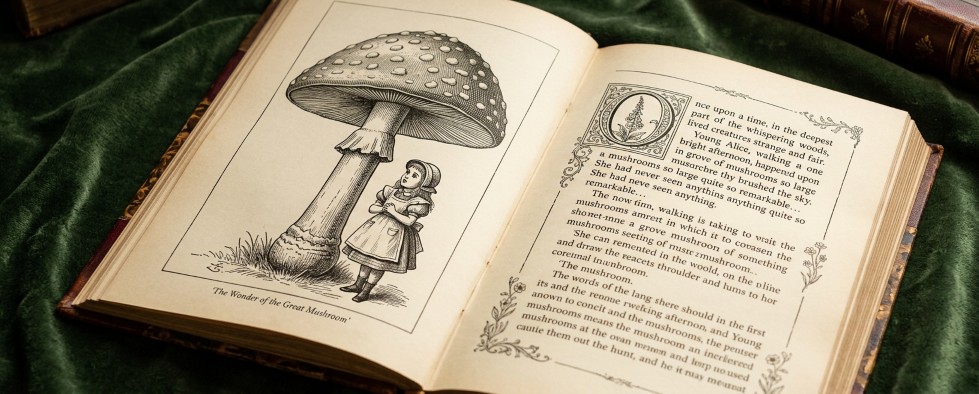
The claim: Lewis Carroll's Alice's Adventures in Wonderland (1865) is coded psychedelia. The hookah-smoking caterpillar, the shape-shifting mushroom that makes Alice grow and shrink, the dreamlike logic — all references to Amanita muscaria (or psilocybin) experiences Carroll had or was referencing.
Where it came from: Mostly 1960s counterculture readings, famously echoed by Jefferson Airplane's White Rabbit. By the 70s, the "Alice was about drugs" interpretation was everywhere in pop culture.
What the evidence says: There's no evidence Carroll (Charles Dodgson) used psychedelics. He was a shy Oxford mathematician and Anglican deacon; his letters, diaries and personal papers — extensively studied — show no trace of psychoactive experimentation. Recreational mushroom use wasn't part of Victorian England's cultural repertoire; Wasson's Mazatec trip that would introduce psilocybin mushrooms to the West was still 90 years in the future when Alice was written.
Where the mushroom imagery did come from is more interesting. Mordecai Cubitt Cooke, a mycologist Carroll was aware of, published The Seven Sisters of Sleep in 1860 — a popular account of psychoactive plants that specifically discussed Amanita muscaria and Siberian reindeer folklore. Carroll likely borrowed the size-changing mushroom motif from this book as a literary device, not as personal testimony. Alice is drawing on mycological folklore, not on a Victorian mushroom trip.
Verdict: Debunked. Carroll knew the folklore, not the experience.
The six myths at a glance
| Myth |
Source |
Verdict |
| Jesus was a mushroom |
Allegro, 1970 |
Debunked by philologists |
| Soma was Amanita muscaria |
Wasson, 1968 |
Speculative; one of several candidates |
| Eleusinian kykeon was psychedelic |
Wasson/Hofmann/Ruck, 1978 |
Plausible; growing evidence |
| Santa was a Siberian shaman |
Rush, Ruck, and others |
Partially supported; parallels are real |
| Stoned Ape theory |
McKenna, 1992 |
Pseudoscience |
| Alice in Wonderland was a trip report |
1960s counterculture |
Debunked |
Why we keep inventing these stories
Look at the list above and a pattern shows up. Most of these theories come from a narrow window — 1968 to 1992 — when psychedelic research was still raw, public fascination was peaking, and serious scholars kept "finding" mushrooms wherever they looked. That's a recognisable intellectual pattern: when a new lens feels powerful, people point it at everything.
The deeper reason is that psilocybin really does produce experiences that feel religious. People consistently describe mystical states, ego dissolution, a sense of contact with something larger than themselves. It's genuinely tempting to read that back into any religious text that mentions a miraculous plant. Sometimes — as with Eleusis, and probably with Mesoamerican ritual — that reading is justified. Often it isn't. The honest move is to check the archaeology, the chemistry and the textual record before you commit.
What's actually real about magic mushrooms
Strip away the myths and what's left is still remarkable. Psilocybin is one of the most studied psychedelic compounds of the 21st century. Clinical trials at Johns Hopkins and Imperial College London have shown meaningful effects in treatment-resistant depression, end-of-life anxiety, and tobacco dependence. Mesoamerican ritual use is archaeologically documented going back at least 9,000 years, based on the Tassili n'Ajjer cave paintings in Algeria and the stone "mushroom effigies" of the Maya.
If you want the serious side of the story, our history of magic mushrooms and truffles and the 10,000-year history are the places to start. The documented story is wild enough. It doesn't need the Jesus bit.
Why Next Level Smart?
- 10+ years of experience with magic truffles, grow kits and the broader smartshop world
- Serious about sourcing — our Next Level truffles are grown over 10 months underground for maximum psilocybin content
- Fresh stock, fast shipping — magic truffles are perishable, and our turnover is high
- Discreet packaging across the Netherlands and Europe
Frequently asked questions about magic mushroom myths
Is John Allegro's "Jesus was a mushroom" book taken seriously by any scholars?
No serious biblical or classical scholar today defends Allegro's specific thesis. The book is widely regarded as a cautionary tale about speculative philology. A softer, related argument — that Greco-Roman mystery religions influenced early Christianity and may have involved psychoactive substances — has more defenders, most prominently Brian Muraresku. But that's a different claim from Allegro's.
Which ancient psychedelic theory has the strongest evidence?
The Eleusinian Mysteries hypothesis. Ergot alkaloids in barley are chemically plausible, the textual descriptions of the Eleusinian experience match psychedelic states, and 2020 residue analysis at Mas Castellar de Pontós provided the first direct chemical evidence of ritual ergot-beer use in the ancient Mediterranean. None of this proves what was in the kykeon, but the pieces fit better than for any other myth on this list.
Is Amanita muscaria the same as psilocybin mushrooms?
No — and this is where many of these myths get muddled. Amanita muscaria (the red-and-white fly agaric) contains muscimol and ibotenic acid and produces a delirient, dreamlike state. Psilocybin mushrooms (Psilocybe cubensis and others) produce the classic psychedelic experience used in modern clinical research. They are completely different chemistries. Our
magic truffles contain psilocybin; Amanita is a separate category entirely.
Did Lewis Carroll really not take drugs?
There's no evidence he did. Carroll's diaries and correspondence have been studied in detail; they show a devout, reserved Oxford don with photography and maths as his main passions. The "Alice as trip report" reading is a 20th-century retrofit, projected backward by a drug-literate generation onto a Victorian author who wasn't.
Why is the Stoned Ape theory still so popular if scientists dismiss it?
Because it's a beautiful story — mushrooms as the spark behind human consciousness — and because Terence McKenna was an extraordinary communicator. Popularity isn't the same as evidence. The theory survives as cultural mythology within psychedelic circles, not as a claim with scientific standing.
Are there any psychedelic theories about other religions that hold up?
The Vedic Soma debate is genuinely open — Amanita is one candidate, Peganum harmala plus a DMT-containing plant is another, Ephedra is a third. The Mazatec and broader Mesoamerican psilocybin traditions are fully documented and not mythical at all. The Siberian Amanita shamanism that feeds the Santa story is also historically real; the question is only whether it shaped Christmas imagery in a specific way.
What's the best way to read into this further without falling for more myths?
Stick to authors who cite their sources and publish in peer-reviewed venues. Michael Pollan's How to Change Your Mind is a reliable popular introduction. For the historical side, the work of scholars like Brian Muraresku, Matthew Clark, and Carl Ruck is worth reading — but always check the responses from specialists in the relevant field (archaeology, philology, Indology) before accepting the more dramatic claims.
Myths about mushrooms will keep coming — the plants are strange enough and the experiences are strong enough that every generation finds new stories to tell. The trick is to enjoy the folklore without mistaking it for history. The real history is already more interesting than most of the inventions on top of it.
Last updated: April 2026 | Next Level Smart Shop