Last updated: April 2026
A botanical and cultural guide we keep current with new ethnobotanical literature and questions from our readers.
Three South American plants turn up in almost every book on ethnobotany. Banisteriopsis caapi, a liana from the Amazon basin. Chacruna, formally Psychotria viridis, a small tree from the same region. And Mimosa hostilis, nowadays usually classified under the name Mimosa tenuiflora, a pioneer tree from the dry northeast of Brazil. Three different plant families, three habitats, three cultural traditions that sometimes connect and sometimes do not.
Caapi climbs more than thirty metres into the tropical canopy. Chacruna is a close relative of the coffee plant. The deep purple dye long used in Brazilian textile art comes from Mimosa bark. Three plants, each with a history that is at once botanical, agricultural and religious, and all three still actively studied by ethnobotanists, anthropologists and pharmacologists.
Next Level Smart has worked with these plants for more than a decade. We source them directly from long-standing partners in Peru and Brazil. This guide takes each of the three in turn: what they are, where they grow, the role they play within their own traditions, and the forms in which they reach Europe.
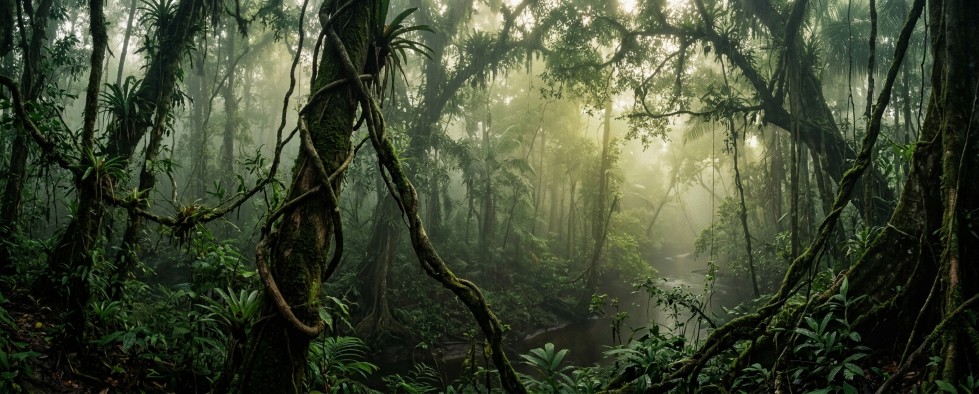
Banisteriopsis caapi, the vine of the ancestors
Banisteriopsis caapi is a woody climbing plant in the Malpighiaceae family. The species grows throughout the western Amazon, from the Peruvian lowlands up into parts of Venezuela, winding its way up the tallest forest trees as a heavy, twisted liana. Specimens thirty metres long are not unusual. The bark carries a distinctive spiral groove that remains visible even in cut sections, along with a heavy, earthy smell that collectors learn to recognise immediately.
The name is Quechua. The same root sits inside the word “ayahuasca”, usually translated as “vine of the soul” or “vine of the dead”. Among the Shipibo-Conibo in Peru, the Shuar in Ecuador, and the Brazilian Santo Daime and União do Vegetal communities, caapi is not treated as a chemical preparation but as a living being with a character of its own. Curanderos speak of the plant in the way one might speak of a teacher: with deference, and with respect for her temperament.
Chemistry and research
The bark of caapi contains a group of alkaloids called the β-carbolines: harmine, harmaline and tetrahydroharmine. These compounds are reversible inhibitors of the enzyme monoamine oxidase, which is what makes them pharmacologically interesting. It is also why caapi has been on the research agenda of universities and institutes for decades. Peer-reviewed publications by Callaway and colleagues in the Journal of Ethnopharmacology (1999) and Riba and colleagues in the Journal of Pharmacology and Experimental Therapeutics (2003) are still widely cited and describe the pharmacokinetics of these compounds in detail. The harmala alkaloids themselves are not regulated in the Netherlands, and the plant is sold legally here as a botanical specimen.
The cultivars
Growers in Peru and Brazil distinguish at least ten cultivars of caapi. Four of them turn up regularly on the European market. The most common is the yellow variety: pale in colour, usually harvested young. The red variety from Peru is rarer, with a reddish inner bark that jumps out the moment you cut through a section. Trueno (Spanish for “thunder”) is a firm cultivar, typically harvested only when fully mature. Caupuri is recognised by the characteristic knobs along the vine.
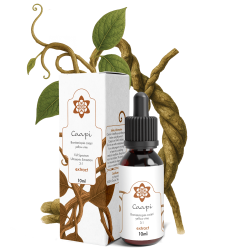
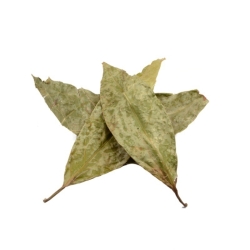
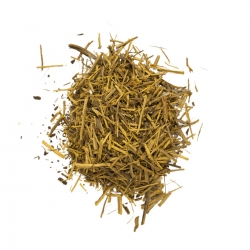
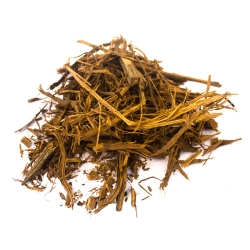
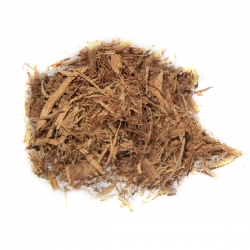
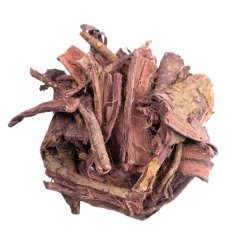
All four are in our collection as shredded vine, suitable for study and collection. The yellow cultivar from Peru is usually the first purchase for a new ethnobotanical collection. Caupuri turns up less often and is instantly recognisable by its knobs. Trueno and the red variety are both harder to come by. For a concentrated form we offer a standardised 3:1 extract of yellow caapi, and for those specifically drawn to the foliage there is dried caapi leaf, valued separately in some traditions.
Growing caapi in the Low Countries
Caapi is a tropical climber that needs warmth and humidity. Below fifteen degrees it starts to struggle, and in the long run dry air is a problem. A heated greenhouse or conservatory with a climbing support to grow against suits it well. In open ground it will not survive the Dutch winter. Collectors who have kept the plant under glass for several years report that it stays healthy as long as there is enough light and the temperature is held steady.
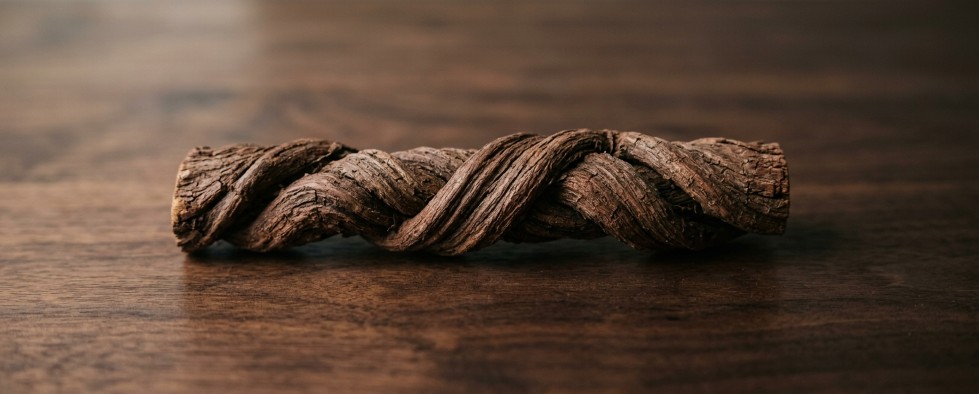
Chacruna (Psychotria viridis)
Chacruna is a shrub or small tree that, in its Amazon setting, rarely grows taller than four or five metres. Not a large climbing plant, then, but a modest presence. Its leaves are glossy, arranged in opposing pairs, and eight to fifteen centimetres long. Botanically chacruna belongs to the Rubiaceae, the same plant family as the coffee plant and the cinchona tree.
The species name chacruna comes from the Quechua word chacru, meaning “to mix”. That points to the role the plant plays in Amazonian cosmology: chacruna is rarely spoken of on its own. In that cosmology it stands for the light, while caapi is the vessel or the journey. The image recurs in the shamanic song cycles and was later taken up by the anthropological literature. It is a cultural figure, not a botanical feature.
DMT and the law
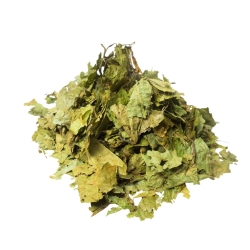
The leaves of Psychotria viridis contain N,N-dimethyltryptamine (DMT), a tryptamine that occurs naturally in hundreds of plant species and has also been identified in mammals. Concentrated DMT is listed under Schedule I of the Dutch Opium Act. The plant itself, including the leaves, is not. Chacruna has been sold by Dutch smart shops as a botanical specimen for years, ourselves included.
Identification
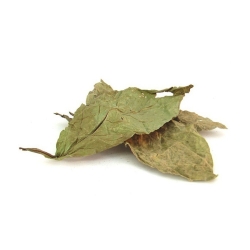
The genus Psychotria contains more than seventeen hundred species. Not every Psychotria is what it appears to be, and not every supplier is equally careful about documenting at species level. Our chacruna leaves come directly from Brazilian suppliers and are documented at species level.
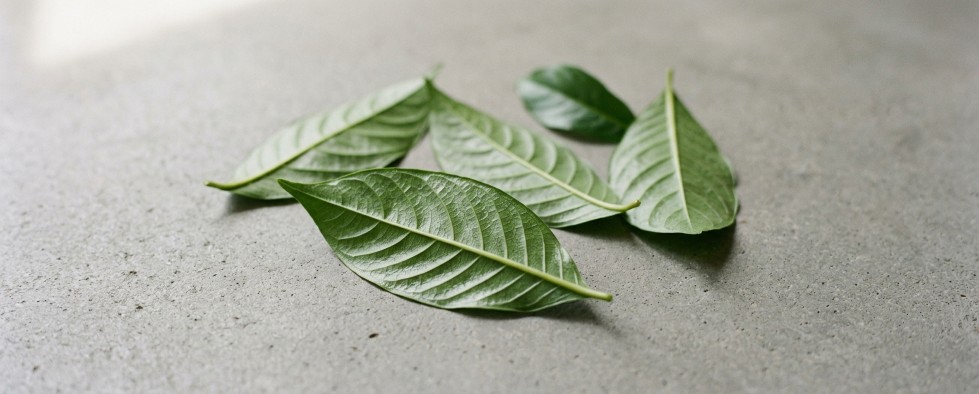
Mimosa Hostilis, Jurema Preta
Mimosa hostilis is the older scientific name, still widely used. The formally accepted name today is Mimosa tenuiflora. Both refer to the same species, and in the ethnobotanical literature you see the two used interchangeably. Botanically Mimosa hostilis is a legume in the Fabaceae family, a fast-growing pioneer tree that reaches between four and eight metres. Its home is not the humid Amazon but the Caatinga, the dry, thorny landscape of northeastern Brazil. It also occurs in parts of Mexico. Its flowers are fluffy and pinkish-white, appearing in dense spherical clusters at the tips of the branches.
In Portuguese the tree is called Jurema Preta, black Jurema. Unlike caapi and chacruna, Jurema Preta does not belong to the Amazon tradition. It sits at the heart of a religious system of its own: the Jurema cult of northeastern Brazil, a syncretic movement that weaves together indigenous Tupi religion, Afro-Brazilian spiritual practice and Catholic saint veneration. The cult has its own hymnal, the cânticos de Jurema, and its own pantheon of mestres and caboclos. A juremeiro is not an ayahuasquero. The confusion is understandable, but these are two separate worlds.
More than one history
Mimosa hostilis is interesting outside the ritual context as well. The Maya have used the bark as a wound-healing balm for centuries, and there is serious dermatological research on its regenerative effect on burn tissue. In southern Mexico and parts of Oaxaca, Mimosa is still a household remedy for skin conditions. The bark also yields a deep purple dye that has held a place in Brazilian textile art for generations. And the wood itself is strong and durable: in the Caatinga it has served for centuries as building material and fencing.
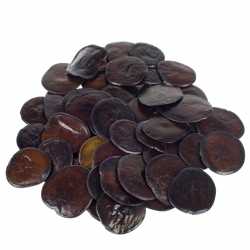
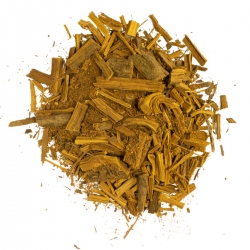
For collectors and researchers we stock Mimosa Jurema flakes from Brazil, finely shredded root bark sourced directly through our Brazilian partners.
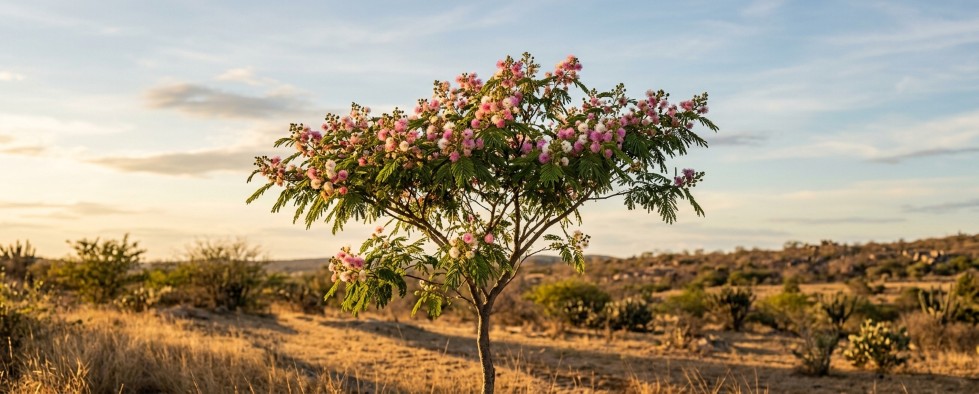
How the three plants relate culturally
Caapi, chacruna and Mimosa hostilis are often named in the same breath, as though they formed a botanical trinity. That is too simple, and it does not do justice to the plants themselves.
Caapi and chacruna have a clear historical connection. Together they form the botanical foundation of what anthropologists call the ayahuasca complex: a ritual system that has existed in the Amazon for centuries and that reached audiences beyond the rainforest during the twentieth century through Santo Daime and UDV. In that context the two plants are never reduced to chemical components of a mixture; they are understood as two distinct teachers who, working together, bring about something neither produces alone.
Mimosa hostilis belongs to a different world. The Jurema cult has its own origin story, going back to the sixteenth century, when indigenous Tupi communities on the northeastern coast of Brazil encountered Portuguese missionaries and enslaved African communities. Some researchers draw links between the ayahuasca complex and the Jurema cult, usually at the level of shared cosmological motifs, but religiously and socially the two are clearly distinct.
What all three traditions share is the premise that a plant is not a thing but a someone. For a Shipibo curandera or a Brazilian juremeiro, that is not a metaphor and not a fashionable notion; it is simply how the world is put together. Anyone who wants to work with these plants, or understand anything real about them, would do well to start from that premise.
Other plants in the same ethnobotanical field
Caapi, chacruna and Mimosa are not the only names in this field. A few others that are often listed alongside them:
Chaliponga (Diplopterys cabrerana) is a liana in the Malpighiaceae family, a close relative of caapi. In Ecuador and Colombia it fills the role chacruna plays further south.
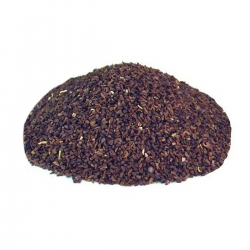
Syrian Rue (Peganum harmala) is native to Central Asia and the Mediterranean. Not an Amazonian species, then, but chemically related to caapi through its harmala alkaloids. Sacred in Zoroastrian and Sufi traditions; in Iran the seeds are still burned as a protective and purifying substance.
Bobinsana (Calliandra angustifolia) is an Amazonian plant without psychoactive properties, with a long history in Peruvian folk medicine as a so-called “plant doctor”. Curanderos cast it as a helper that strengthens the work of other plants.
Yopo (Anadenanthera peregrina) is used by the Orinoco peoples of Venezuela and Colombia, in a ritual context separate from the Amazonian tradition. It is prepared as a snuff, not as a drink.
Each of these plants deserves its own guide. Readers looking for a broader introduction to ethnobotany can turn to our guide to plants that have shaped human culture. And for a portrait of a Western thinker who opened this world to a wider audience, see our piece on Terence McKenna.
Why keep one of these plants at home?
Far from everyone who collects ethnobotanical plants has a ritual use in mind. There are plenty of other reasons to keep a piece of caapi, a pouch of chacruna leaves or some Mimosa bark in the house.
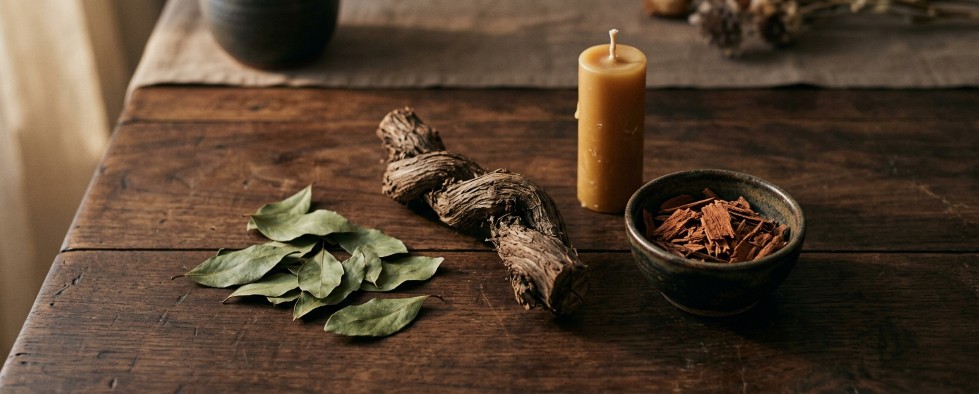
The first is altar work. Many people keep a place somewhere in the home where objects with personal meaning sit together, and a section of liana or a small dish of bark fits naturally there. Not to be used, but to be present. By far the largest share of our ethnobotanical customers buys for this reason.
The second is botanical study. The Netherlands is home to a small but dedicated community of collectors and researchers who approach these plants from anthropological, taxonomic or historical angles. For that audience, accurate species identification is what counts, which is why we insist on it with our suppliers.
The third is cultivation itself. Banisteriopsis caapi is a rewarding project for anyone fond of tropical climbing plants. In a heated space with a climbing support and the right humidity, the plant can keep growing for years. Several private collections in the Netherlands maintain mature specimens under glass.
And for Mimosa there is natural dyeing. The bark yields a deep purple to reddish dye that has held a place in Brazilian textile art for centuries. For textile artists and natural dyers it is a full application in its own right.
How the law sits. The three plants in this guide are sold legally in the Netherlands as botanical specimens. The harmala alkaloids in caapi fall outside the Opium Act. DMT, which occurs in low concentrations in chacruna and Mimosa, does fall under the Act, but only in concentrated form, not as part of the plant. No problem, in other words, with keeping these plants at home as specimens, ornamentals or collector items.
Why Next Level Smart?
We have worked with ethnobotanical plants for more than a decade. In practice that means:
- Direct sourcing from long-standing partners in Peru and Brazil, not through intermediaries
- Species-level identification across everything in our ethnobotanical range
- A broad caapi selection covering yellow, red, Trueno and Caupuri from several regions
- Material in a range of formats for study, collection and ornamental growing, including extracts and shredded vine
- Discreet shipping within the Netherlands and across Europe, with proper care for packaging and customs
Frequently asked questions
Is Banisteriopsis caapi legal in the Netherlands?
Yes. The plant itself, including bark, leaves and extracts, sits outside the Dutch Opium Act. The harmala alkaloids it contains are not scheduled. It can be bought, kept and grown as an ornamental vine without any legal issue.
What is the difference between Mimosa hostilis and Mimosa tenuiflora?
None. The two names refer to the same plant. Mimosa hostilis is the older scientific name, still widely used in ethnobotanical circles; Mimosa tenuiflora is the currently accepted botanical name in modern floras. In practice you encounter both interchangeably, in the literature and in the trade.
Why is chacruna called “the leaf of light”?
It is a poetic description drawn from the shamanic tradition. In Amazonian cosmology chacruna stands for the light that gives the experience its shape, while caapi is the vessel that carries it. The image comes from the song cycles of curanderos and was later picked up by the anthropological literature. A cultural figure, not a botanical feature.
Can I grow a caapi vine in the Netherlands?
Under glass, yes. Caapi is tropical and needs temperatures above fifteen degrees along with high humidity. In a heated greenhouse or conservatory with a climbing support, the plant does well and can last for many years. In the garden it will not survive the Dutch winter.
What exactly is the Jurema cult?
A religious tradition from northeastern Brazil in which Mimosa hostilis, under the name Jurema Preta, holds a central position. The cult is a syncretic blend of indigenous Tupi religion, Afro-Brazilian practice and Catholic saint veneration, with its own liturgy, hymnal and pantheon. It is distinct from the Amazonian ayahuasca tradition, with a history of its own going back to the sixteenth century.
Why do you sell these plants?
Because there is serious demand from collectors, researchers, textile artists and people who work with altars. For that audience these plants have been a familiar part of the ethnobotanical trade for decades.
What is the difference between Peruvian and Brazilian caapi?
There are subtle differences in alkaloid profile and appearance, usually traceable to climate, altitude and harvesting method. Peruvian caapi tends to come from higher, drier terrain; Brazilian caapi from wetter lowland. The differences between cultivars are often more visually striking: Caupuri is recognised by its thick, swollen nodes; Trueno is smoother and firmer; Yellow and Red differ in the colour of the inner bark.
Does caapi itself contain DMT?
No. Banisteriopsis caapi contains no DMT. What it does contain are β-carboline alkaloids: harmine, harmaline and tetrahydroharmine. The DMT associated with the ayahuasca tradition comes from other plants, usually chacruna, sometimes chaliponga. This is a common misconception, so worth setting straight.