Blog navigation

Latest posts

Magic Truffles by Strength: From Gentle to Strongest

Not every magic truffle is equally strong: there is a world of difference between a gentle Mexicana and a hefty High...

Read More
Indica, Sativa and Ruderalis: The Real Difference Explained

Indica, sativa and ruderalis: the three names you will find on almost every pack of cannabis seeds. But what do they...

Read More
What is DMT? The Molecule, Its Sources, and What Science Says

A complete guide to DMT — what the molecule is, where it occurs in plants and animals, how the human body produces...

Read More
White Sage: The Smudging Herb From California, From Plant to Practice

A guide through white sage — how Salvia apiana smells and works, where it comes from, the difference between...

Read More

Does Santa Have Anything to Do with Magic Mushrooms? Let’s Look at the History.


Last updated: June 2026
This guide is regularly updated with the latest insights.


Many of us around the world have grown up with a story of Santa Claus and his reindeers, emerging from the cold North Pole once a year to fly around the globe and shove gifts down the chimneys of children who’ve behaved well. As magical as it is, there comes a point in our childhood that we realise this magical story we believed so intensely turns out to be a farce.

But what if this story turned out to be based on something real rather than purely imagined? What if there was historical evidence showing that perhaps the Santa Claus we know today has originally had something to do with magic mushrooms?


Santa Claus and Magic Mushrooms

santa claus magic mushrooms

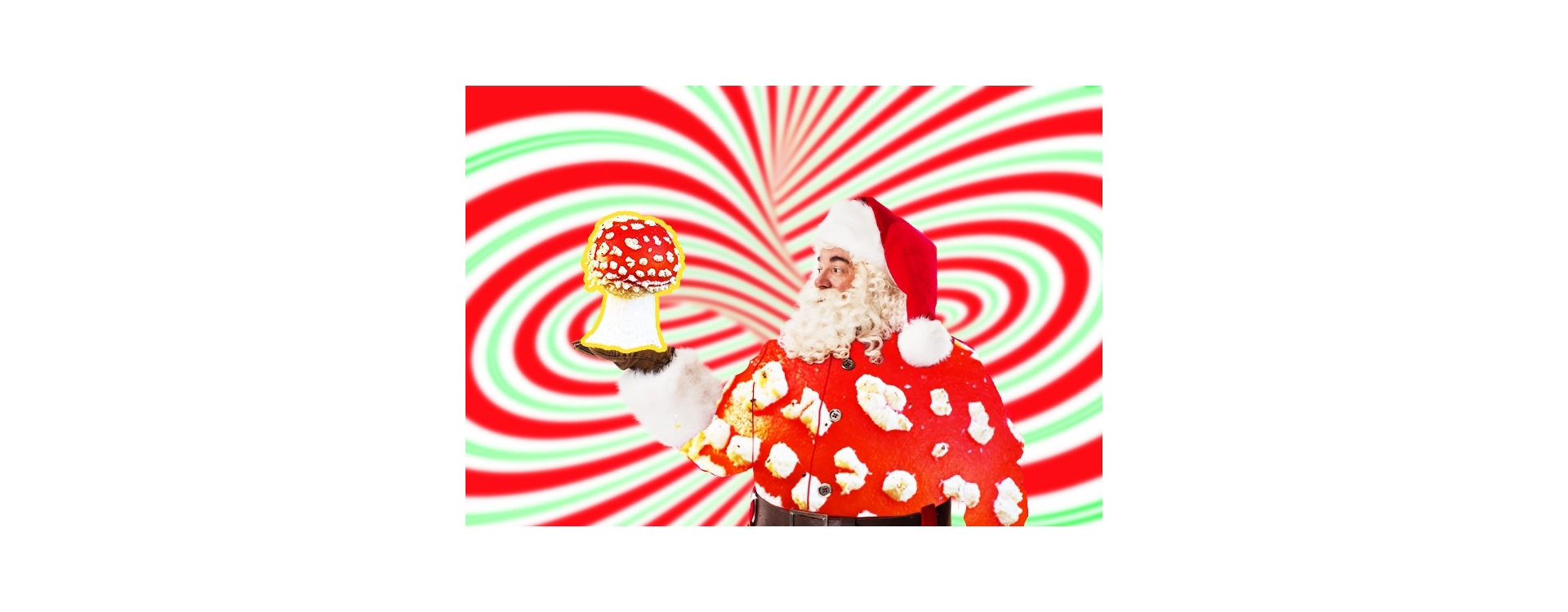
If we look at the history of Siberian and Arctic regions, a legend tells that around the time of winter solstice, shamans dressed in red and white would drop into locals’ teepee homes to gift them hallucinogenic mushrooms.

“Santa is a modern counterpart of a shaman, who consumed mind-altering plants and fungi to commune with the spirit world”, states John Rush, an anthropologist and instructor at Sierra College. “As the story goes, up until a few hundred years ago these practicing shamans or priests connected to the older traditions would collect Amanita Muscaria (the Holy Mushroom), dry them, and then give them as gifts on the winter solstice.”

Certain things and evidence from these stories seem to be a bit more than just a coincidence, and greatly resembles the current Christmas narrative in the modern times. Let’s look at some of them!


Gifts sent down the chimney

Since Siberia is way up in the north of the globe, anyone can imagine that wintertime there would truly look like a Winter Wonderland fairytale with all its land deeply covered in snow. "Because snow is usually blocking doors, there was an opening in the roof through which people entered and exited, thus the chimney story,” says Rush.


Red and White Colours

The legend goes that local shamans would dress in red cloaks covered with white dots, representing the magic mushroom Amanita. Please note that this mushroom in its fresh form can be poisonous, therefore, the shamans dried them before gifting them away to the locals. 
Interestingly, traditional Christmas gift wrappings also are found to be red and white.


Reindeers

santa claus and magic mushrooms

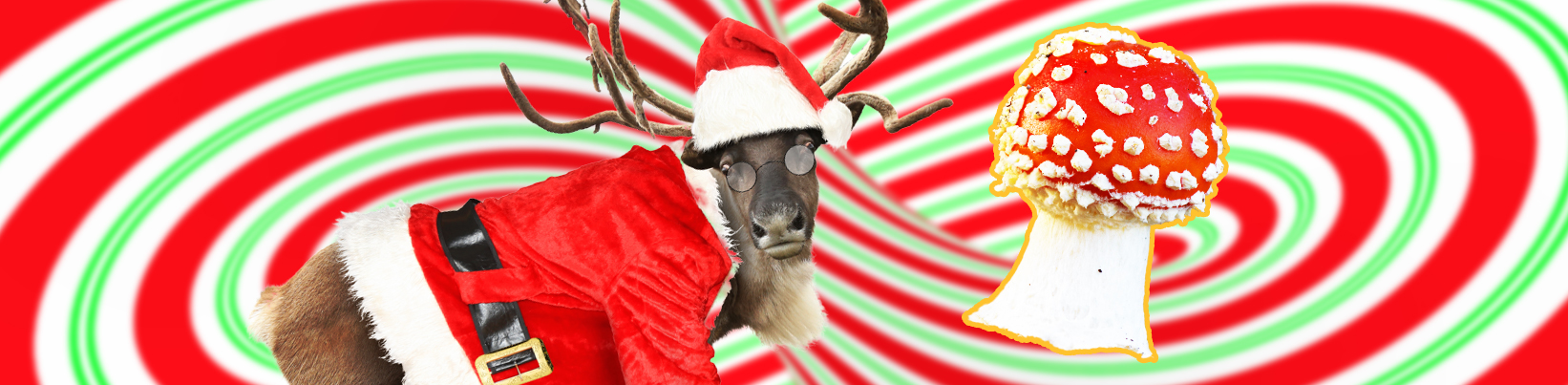
"Amongst the Siberian shamans, you have an animal spirit you can journey with in your vision quest," Ruck continued. "And reindeer are common and familiar to people in eastern Siberia.” Not only reindeers were seen as powerful spirit animals to journey with, but it’s been found that reindeer themselves are fond of Amanita Muscaria psychoactive mushrooms. Deputy editor of the Pharmaceutical Journal, Andrew Haynes, wrote in 2010 that animals deliberately seek out the red and white spotted mushroom in their habitats, as they “have a desire to experience altered states of consciousness.” It is quite possible to experience a feeling of “taking a trip” with a reindeer given that these were important animals to the local shamans, and possibly even having a sensation of “flying” while on psychedelic substances. Funnily enough, reindeer Rudolf’s nose is in bright red colour - just like the magic mushroom Amanita Muscaria found in the area.


Gifts under a Christmas tree

In Mushrooms and Mankind, James Arthur points out the connection: “Why do people bring pine trees into their houses at the winter solstice, placing brightly coloured (red-and-white) packages under their boughs, as gifts to show their love for each other? It is because, underneath the pine bough is the exact location where one would find this ‘Most Sacred’ substance, the Amanita Muscaria, in the wild.”


Conclusions

Whether Santa Claus story truly originated from Siberian shaman traditions we may never know. Many historians are arguing over this topic with many believing that there are just too many similarities for them to be a coincidence while others argue that stories, poems, and legends are not enough to come to any conclusions. What are your thoughts on the subject?

Either way, we think that Christmas is a wonderful time to treat yourself with some magic mushrooms! Why not follow a tradition of Siberian shamans and explore the world of psychedelic mushrooms?

Frequently asked questions about Santa and magic mushrooms

Does Santa really come from mushrooms?

It is a popular theory, not a proven fact. Some researchers draw links between Siberian shamans, the red-and-white fly agaric and later Christmas symbols. Others find those links too speculative. It remains a fascinating story.

Which mushroom is central to this story?

The fly agaric (Amanita muscaria), with its red cap and white spots. This mushroom featured in Siberian shamanic traditions and is said to have inspired the red-and-white colours of the Christmas figure.

Why are reindeer mentioned in this story?

In Siberia, reindeer graze on fly agaric and then show striking behaviour. The theory says this inspired the image of "flying" reindeer. Whether that is the true origin stays uncertain, but it fits the tale nicely.

Is the fly agaric the same as a magic mushroom?

No. The fly agaric contains muscimol and ibotenic acid, different compounds from the psilocybin in magic mushrooms. They are two completely different mushrooms with very different effect and risk profiles.

Can I legally grow mushrooms myself?

Fresh magic mushrooms are banned in the Netherlands, but grow kits and spores contain no psilocybin yet and are legal. Magic truffles are also permitted.

Is this story scientifically proven?

No. The Santa-mushroom theory is folklore and cultural interpretation, not settled history. It is fun to ponder, but take it with a pinch of salt. The modern Santa Claus has had many influences.

Last updated: June 2026 | Next Level Smart

 
Annie Verkade is a writer at Next Level Smartshop with a background in philology. She writes about natural alternatives to pharmaceuticals, sleep support, and plant-based products. Her work also explores altered states of consciousness - both with and without psychedelics - as well as topics like astrology and lunar cycles, translating insights into clear, accessible content. She’s especially interested in how simple rituals and environment can shift how we feel (sometimes more than we expect). Outside of work, she enjoys photography, reading, bouldering, and travelling. Favourite products: Sagrada Madre incense, Mulungu, Sleep Tincture
Loading...