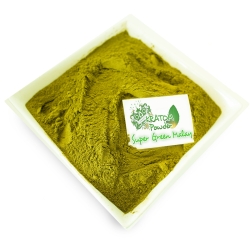
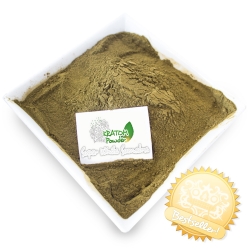
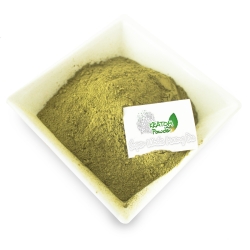
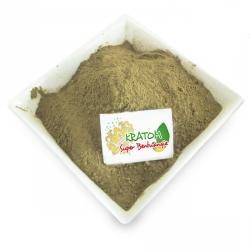
Walk into any smart shop and you will see kratom sorted by colour: red, green, white and sometimes yellow. Most explanations follow a simple story: "Red kratom comes from leaves with red veins, white from leaves with white veins." That story is partly true — but the full picture is more nuanced and more interesting.
The four colour names are primarily marketing categories based on the vein colour of the fresh leaf. The actual chemical differences between batches come from a combination of factors: leaf age, harvest moment, regional and genetic variation and additionally processing style and possible blending. A recent doctoral thesis from Maastricht University (Prevete, 2025) confirms these factors explicitly: variation in alkaloid content between kratom products is explained mainly by "season of growth, leaf maturity, and regional differences".
In this guide we unpack how these factors work together, what the names red, green, white and yellow actually tell you, and how blending — a common and skilful practice in the kratom industry — plays its own role.
Mitragyna speciosa: the plant behind the powder
Kratom is a tropical evergreen tree in the Rubiaceae family — the same plant family as coffee. The scientific name is Mitragyna speciosa, first formally described in 1839 by the Dutch botanist Pieter Willem Korthals. The tree grows naturally in Southeast Asia and can reach 15 to 25 metres in optimal conditions. On commercial plantations trees are usually harvested from 6 to 15 years of age; more detail on our own plantations is in our blog about our kratom factory in Indonesia.
The leaves are oval-elongated and can grow up to 20 centimetres long. According to recent literature (Prevete, 2025; earlier reviews such as Cinosi et al., 2015), the plant contains more than 50 alkaloids, of which four are considered pharmacologically active: mitragynine, 7-hydroxymitragynine, paynantheine and corynantheidine. The latter two are isomeric forms of mitragynine. Mitragynine alone often makes up to 66% of total alkaloid content; together with 7-hydroxymitragynine it accounts for roughly two-thirds of the active fraction.
The main alkaloid mitragynine was first isolated in 1921 (Field) and only fully structurally defined in 1965 (Beckett et al.). Substantial peer-reviewed human research has only followed in the past ten to fifteen years, including the first placebo-controlled phase-1 trial in 2024 at Maastricht University.
Vein colour, leaf age and harvest moment: the leading role
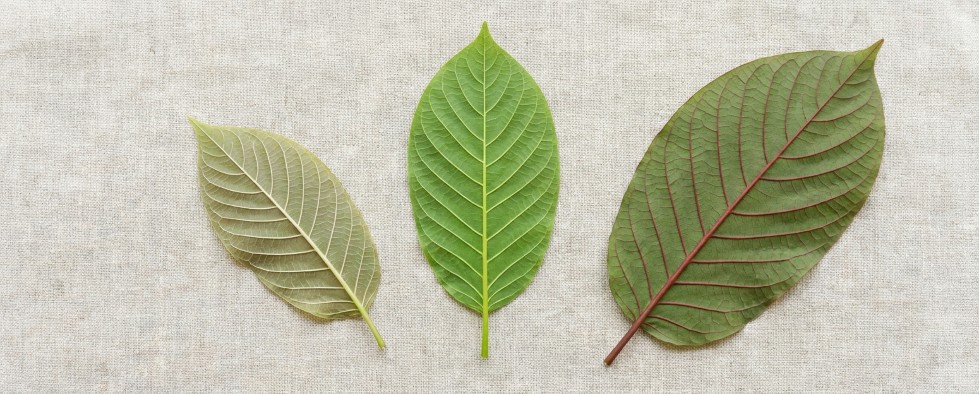
The veins of a kratom leaf change colour as the leaf matures. A young, freshly emerged leaf has pale, almost whitish veins. At mid-maturity the veins turn green. On old, fully grown leaves the veins often develop a deep reddish hue. This is botanical fact — and the basis for the names "white vein", "green vein" and "red vein" in the kratom industry.
Vein colour is not just a visual feature — it is a maturity indicator, and with leaf age the underlying alkaloid ratios also shift. Younger leaves carry a different mitragynine/7-hydroxymitragynine balance than mature leaves. On our plantations at Jongkong (West Kalimantan) harvesters select leaves by hand based on vein colour and leaf structure, typically in the early morning between 7:00 and 13:00, to gather material with the highest possible alkaloid content.
Harvest moment in the year also plays a role. The tropical regions where kratom grows have alternating dry and wet seasons. Dry-season leaves show a mild stress response and often carry higher alkaloid concentrations; wet-season leaves grow faster but with slightly lower density. Prevete (2025) names these three factors — season, leaf age and regional/genetic variation — as the primary source of variation between kratom products.
Vein colour is therefore, in essence, a proxy for leaf age, and it is through leaf age that the link to the final product runs. The industry habit of naming products after vein colour is not nonsense — it is a simplified but functional labelling convention.
The drying process: a supporting role
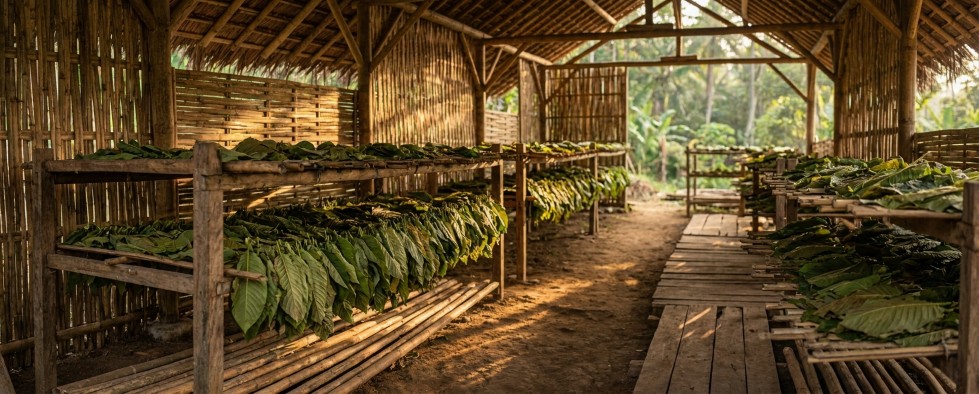
After harvest comes drying. Contrary to what some marketing stories suggest, the basic drying process for most kratom is similar: leaves are dried to the right moisture content under controlled conditions. Drying is therefore not the main driver of colour differences — those lie mostly in the leaf selection described above.
Within certain categories there are small process variations. For some red varieties a slightly extended drying time or a mild oxidation phase can take place, darkening the leaf material and shifting the alkaloid profile a little. This sits closer to careful temperature, humidity and duration control than to the large-scale fermentation processes you might read about in other botanical industries (such as tea).
At our facility drying is fully controlled. We use climate-managed rooms that precisely regulate temperature, humidity and air circulation, because alkaloids are sensitive to UV light, high temperatures and humidity. More on our approach — and on why traditional sun-drying in Indonesia causes problems — is in our blogs on our drying facility and the problem of kratom.
The four colours: what actually distinguishes them?
Red kratom
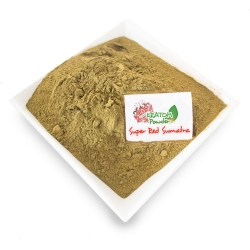
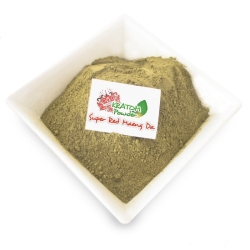
Red kratom is traditionally associated with mature leaves with red veins. In production a slightly extended or mildly oxidative drying process can darken the leaf material — a reddish-brown tone. The characteristic colour of the final powder therefore arises partly from leaf selection (oldest leaves with the highest mitragynine concentration) and partly from process handling. Popular red varieties in our range include Super Red Sumatra, Super Red Borneo and Super Maeng Da Red.
Green kratom
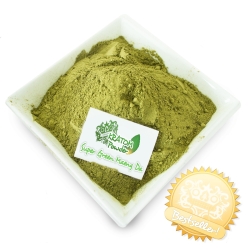
Green kratom typically comes from leaves around mid-growth, with green veins. The drying process is usually straightforward: controlled indoor drying without extended oxidation. As a result the chemical composition stays relatively close to that of the fresh leaf — a reason green varieties are often described as the most "balanced" in alkaloid spectrum. Our green range includes Super Green Malay, Super Maeng Da Green and Super Green Elephant — the last named after its strikingly large leaves.
White kratom
White kratom traditionally comes from younger leaves with pale veins. Drying is quick, controlled indoors and with limited light to keep oxidation to a minimum. The end result is a light-coloured, fine powder. Popular white varieties are Super White Sumatra and Super Maeng Da White.
Yellow kratom
Yellow kratom is the most specialised of the four and is produced in two ways — sometimes combined:
- Special drying process — multi-stage drying in which the leaf material undergoes a specific mild oxidative treatment, resulting in a golden tone.
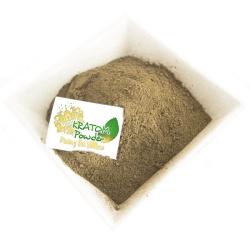
- Blending — a carefully composed mixture of existing colours (often red with green) yielding a final product with its own alkaloid profile and golden-yellow colour.
Which approach is used varies by producer. Our yellow variant is Super Maeng Da Yellow.
Blends: a craft in their own right
Blending — deliberately combining different cuts or cultivars — is a common and respectable practice in the kratom industry. Just as with coffee, tea or cacao, blending lets producers deliver consistent end products, design specific profiles and absorb seasonal variation between harvests. It is a craft in itself.
In practice this means:
- Many commercial kratom products are partial blends for consistency between batches
- Some variant names refer specifically to a blend recipe (yellow kratom is a good example)
- "Maeng Da" lines are often composed of hand-selected top cuts from multiple batches
- Speciality varieties like Bentuangie deliberately combine different styles for a unique profile
Blending lets producers absorb the natural variation between harvests, shape specific alkaloid profiles and deliver consistent end products — much like a coffee roaster or tea master does. It is a craft that turns seasonal variation into reliable quality, and as such an essential part of modern kratom production.
Region names: marketing and tradition
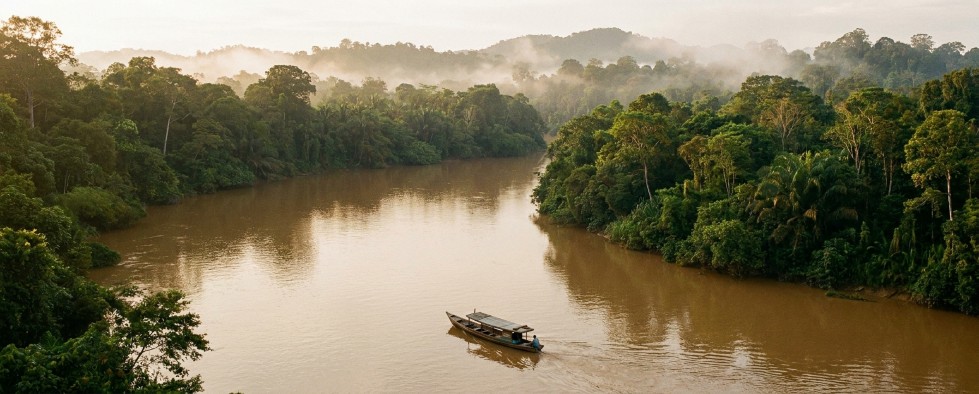
The region names on kratom packaging — Bali, Sumatra, Malay, Thai, Borneo — are largely historical marketing labels, not botanical or geographic precision. A few facts on the record:
- The vast majority of European commercial kratom comes from Indonesia, primarily West Kalimantan (the Indonesian part of Borneo).
- "Bali kratom" rarely comes from Bali itself. The name dates from the era when Balinese ports were a trade hub for Indonesian kratom — the name stuck after production shifted to Kalimantan.
- "Malay kratom" rarely comes from Malaysia. Mitragyna speciosa has been under the Malaysian Poisons Act since 1952, so commercial export is not legal. The name usually refers to a Malaysian processing tradition or genetic line.
- "Thai kratom" rarely comes from Thailand. Thailand banned kratom in 1943 with the Kratom Act 2486 to protect opium tax revenue. Only in 2021 was it partially re-legalised for medical use. Until then, virtually all commercial export was Indonesian — a pattern that continues today.
- "Sumatra kratom" sometimes refers to truly Sumatran material (especially from Aceh), but much of it is still Kalimantanese with a Sumatran processing style.
At our shop, the names "Borneo", "Bali", "Sumatra" and "Malay" refer to specific processing traditions, genetic lines and cuts — not to physical harvest location. All of our kratom comes from a single source: our own plantations and processing facility in Jongkong, West Kalimantan.
Maeng Da and Bentuangie: speciality varieties explained
Maeng Da is not a region, not a place and not a separate botanical variety. The term comes from Thai street slang and has for decades been used in the kratom industry as a quality label — a designation for "top" or "premium" material. Practically it refers to a selection of hand-picked, usually larger and more mature leaves. Maeng Da products are often premium-cut blends for maximum consistency and exist in all four colours: red, green, white and yellow.
Bentuangie is a speciality variety with its own story. It is produced in the Jongkong region (West Kalimantan) using leaves of specific, medium maturity — not the youngest, not the oldest. The processing is extended and carefully managed, and the result is a distinctive blend with an alkaloid profile that sits between red and green kratom. In doing so Bentuangie combines characteristics that do not normally appear together so pronouncedly. Our Super Bentuangie is produced in-house on the same plantation as our other kratom.
Comparison table: the four colours
| Aspect |
Red kratom |
Green kratom |
White kratom |
Yellow kratom |
| Often-chosen leaf |
Mature, red vein |
Mid-mature, green vein |
Young, pale vein |
Varies by method |
| Drying style |
Sometimes lightly extended or mildly oxidative |
Controlled indoor |
Fast, controlled, low light |
Multi-stage or as a blend |
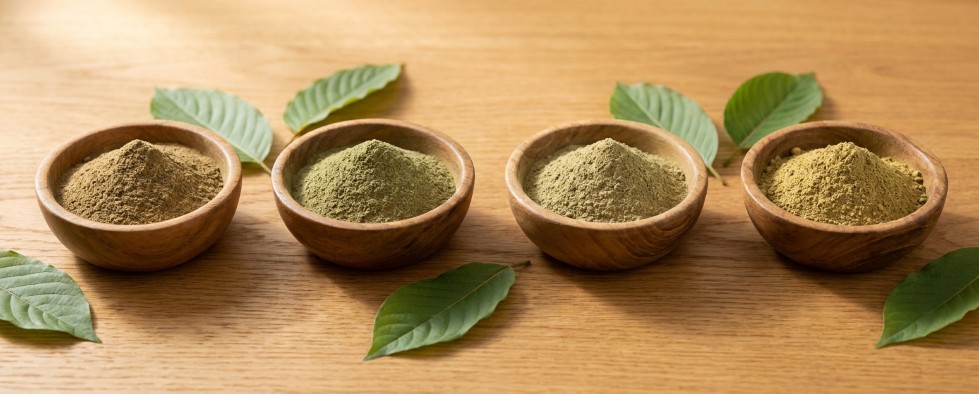
| Powder colour |
Dark reddish-brown |
Rich green |
Light green/beige |
Yellow-gold |
| Single-origin or blend |
Both common |
Both common |
Both common |
Often a blend |
| Availability |
Very common |
Common |
Common |
Limited |
Kratom in cultural-historical perspective
Kratom has a long history in the native regions of Southeast Asia. Historical sources document that the plant was chewed by workers in rural industries in 19th-century Malaysia and southern Thailand — generations before it appeared in Western smart shops. Western botanical history begins in 1839, when Pieter Willem Korthals first described the plant as Mitragyna speciosa.
Two important regulatory milestones followed:
- 1943, Thailand — the Kratom Act 2486 prohibits kratom to protect opium tax revenue. The ban remains in force for nearly eight decades. In 2021 kratom is partially re-legalised in Thailand, first for medical use and later for food.
- 1952, Malaysia — Mitragyna speciosa is placed under the Poisons Act, where it remains today. Commercial export from Malaysia is therefore not legal.
Indonesia took a different route. From the 1990s onwards a legal, structured production chain developed in West Kalimantan, from which most contemporary international kratom trade originates. Our own plantations and facility in Jongkong are part of this sector — more on this in our blog about our kratom factory in Indonesia.
How we ensure quality
The quality spread in commercial kratom is wide. A batch that has been poorly dried, sat too long in storage, or been mixed with stems or leaf debris looks identical to the untrained eye as a properly processed batch — but differs considerably in alkaloid profile and purity. A broader analysis is in our blog about the problem of kratom.
Our approach rests on three pillars:
- Single-source production — all kratom comes from our own plantations and processing facility in Jongkong, West Kalimantan; no middlemen, one source.
- Controlled drying process — we dry in climate-managed rooms instead of traditional sun-drying, to protect the sensitive alkaloids from UV light, high temperatures and humidity fluctuations.
- Lab testing per batch — alkaloid content (mitragynine, 7-hydroxymitragynine), heavy metals (lead, cadmium, arsenic, mercury) and microbiology (mould, bacteria).
Customers who try multiple varieties often notice that rotating between different colours and styles keeps the experience varied. On our kratom overview page you will find the complete range sorted by colour.
Why Next Level Smart?
- More than 10 years of experience with kratom sourcing and ethnobotanical products
- Own plantations and facility in Jongkong (West Kalimantan) — from tree to package, one source
- Controlled drying process in climate-managed rooms instead of traditional sun-drying
- Every batch independently lab-tested — alkaloids, heavy metals, microbiology
- 30+ kratom products across all four colours, plus extracts, leaves and specialities like Bentuangie
- Fast, discreet shipping across the Netherlands and throughout Europe
Frequently asked questions about kratom colours
What is the difference between red, green, white and yellow kratom?
The colour names refer primarily to the vein colour of the fresh leaf — a maturity indicator. Mature leaves have red veins, mid-mature leaves green, young leaves pale. Because alkaloid ratios differ by leaf age, the end products differ as well. Additional process variations (light oxidation for red, fast drying for white) and blending further refine the profile. The tree itself — Mitragyna speciosa — is the same species for every colour.
Does the vein colour of the fresh leaf determine the kratom colour?
To a meaningful extent yes, but indirectly. Vein colour is a maturity indicator — pale on young leaves, green at mid-maturity, red on mature leaves — and leaf age co-determines the alkaloid ratios in the material. Harvesters select leaves on vein colour because it is the most reliable visual cue. The drying process that follows reinforces or refines this further. Recent literature names season, leaf age and regional variation as the primary sources of variation (Prevete, 2025).
Does harvest season matter?
Yes. Leaves harvested in the dry season often carry higher alkaloid concentrations than wet-season leaves — the plant shows a mild stress response in drier periods. Time of day can also make a difference; many native producers harvest in the early morning for the best result. Good lab-testing work catches this seasonal variation.
What is Mitragyna speciosa?
Mitragyna speciosa is the scientific name of the kratom tree. It belongs to the Rubiaceae family — the same plant family as coffee — and grows naturally in Southeast Asia. The plant was first formally described in 1839 by the Dutch botanist Pieter Korthals. The leaves contain more than 50 alkaloids; four are considered pharmacologically active: mitragynine, 7-hydroxymitragynine, paynantheine and corynantheidine (Prevete, 2025).
What does Maeng Da mean?
Maeng Da is not a region, not a place and not a separate plant species. The term comes from Thai street slang and is used in the kratom industry as a quality label — a designation for "top" or "premium" material. Practically it is a selection of larger, more mature leaves or a premium-cut blend. Maeng Da exists in all four colours: red, green, white and yellow.
Does Bali kratom really come from Bali?
No, rarely. Kratom is barely commercially cultivated on Bali. The name dates from the era when Balinese ports were a trade hub for Indonesian kratom — the name stuck after production shifted to West Kalimantan (Borneo). Most "Bali" kratom on the European market is in reality Kalimantanese material with a Balinese processing or naming tradition.
And "Thai" or "Malay" kratom?
Almost always Indonesian. Thailand banned kratom in 1943 with the Kratom Act to protect opium tax revenue; only in 2021 was it partially re-legalised. Malaysia has had Mitragyna speciosa under the Poisons Act since 1952, making commercial export illegal. "Thai" and "Malay" on the European market are almost always references to processing style or genetic line, not to physical harvest location.
Are kratom powders blended?
Yes, blending is common in the kratom industry — just as with coffee, tea and cacao. Producers use it to deliver consistent end products, design specific profiles and absorb seasonal variation. Some products are deliberately blends (such as much yellow kratom and some Maeng Da lines), others are single-origin. Good shops indicate where possible which category their products fall into.
What is Bentuangie?
Bentuangie is a speciality variety from the Jongkong region (West Kalimantan). It is produced using leaves of medium maturity — not the youngest, not the oldest — and an extended controlled processing step. The result is a distinctive blend with an alkaloid profile that sits between red and green kratom; in doing so it combines characteristics that do not normally appear together so pronouncedly. Our Super Bentuangie is produced in-house on the same plantation as our other kratom.
How is kratom produced?
The production chain has six main steps: harvest (manual leaf selection on vein colour and maturity), washing and sorting, drying under controlled conditions, milling to fine powder, lab-testing for alkaloid content and contaminants, and packaging in airtight UV-resistant material. At our facility every step is carried out in-house at Jongkong. More detail is in our blogs on our kratom factory and our drying facility.
How do I recognise good-quality kratom?
Look for fine, consistent powder without visible stems or coarse leaf debris. The colour should be rich and uniform — dull or patchy colouring may indicate poor processing or old stock. A fresh, herbal-earthy aroma is a good sign; musty or sharp smells indicate bad drying. Reputable sellers test every batch for alkaloid content, heavy metals and microbiology. More details in our blog on the problem of kratom.
Where does Next Level Smart kratom come from?
Our kratom comes from a single source: our own plantations and processing facility in Jongkong (West Kalimantan, the Indonesian part of Borneo), around the Kapuas river. We manage the full production chain in-house — harvesting, drying, milling, testing and packaging — with no middlemen. Read the full story in our article about our kratom factory in Indonesia.
Disclaimer: Kratom (Mitragyna speciosa) is not approved as a novel food or food ingredient in the EU under Regulation (EU) 2015/2283. Next Level Smart does not sell kratom for human consumption. The information in this article is intended for educational and botanical purposes only and does not constitute medical, health or consumption advice. Always consult a qualified professional for health-related questions.
Last update: May 2026 | Next Level Smart