Light a white sage bundle and within ten seconds a thick column of pale smoke threads its way across your room, with a fresh herbal scent — somewhere between rosemary, eucalyptus and pine forest — that settles into every corner.
The plant is Salvia apiana, it grows only along the Californian coast, and it carries a story bigger than the little stick in your hand. This guide walks through everything that matters: how white sage actually works, where it comes from, how to tell a good bundle from a poor one, how to light one carefully, and how to use it respectfully — a subject that asks for a touch more attention in 2026 than it did ten years ago.
The plant behind the scent: Salvia apiana
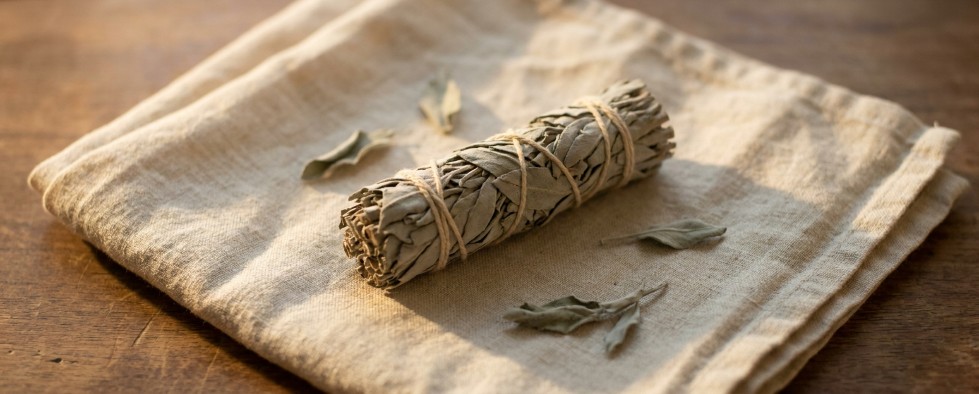
White sage is botanically Salvia apiana. The species name apiana comes from the Latin for "of bees" — a nod to the fact that the plant in bloom is one of the most attractive nectar sources for wild bees across Californian habitats. Anyone cultivating white sage for smudging is, by extension, also keeping a bee restaurant. An unexpected detail that adds a layer rather than diminishing the ceremonial use.
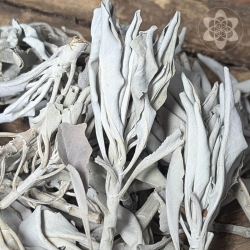
The shrub reaches one and a half metres in height, has long lance-shaped leaves covered in fine white hairs — the source of the silvery-grey sheen — and flowers in spring with white to light purple spike-shaped blooms. It is a close relative of kitchen sage (Salvia officinalis), but confusing the two is unhelpful: leaf chemistry, scent and use sit far apart. White sage carries a much higher concentration of eucalyptol and camphor than the kitchen variant. Crush a few raw leaves of each side by side and you smell the difference immediately.
The plant grows naturally only in a narrow strip of around three hundred kilometres along the Californian coast and into northern Mexican Baja California. That region — dry chaparral with rocky soil, little rain, plenty of sun — partly explains why the leaf chemistry is so intense. Growing white sage on a Dutch windowsill works for a few years, but the leaves never reach the oil concentration of plants from their native region.
The scent and what makes it distinctive
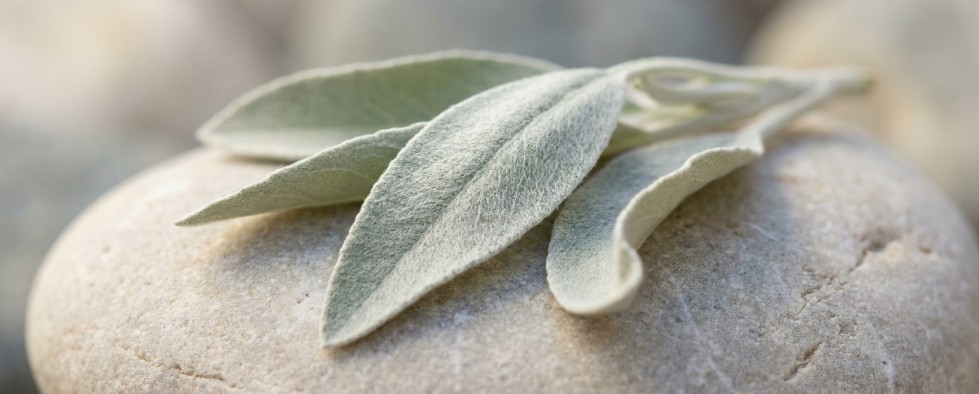
White sage smoke comes from slow combustion of essential oils stored in the leaf cells. Three molecules contribute the most to the characteristic profile:
- Eucalyptol (1,8-cineole) — responsible for the fresh-herbal, lightly menthol top note. The same molecule appears in high concentration in eucalyptus and rosemary; that's where the association sits.
- Camphor — gives the sharp, penetrating undertone that distinguishes white sage from other herbal smoke. Lower concentration than in actual camphor tree wood, but audibly present.
- α-pinene — the resinous, pine-forest layer underneath. The same molecule you smell in a pine forest on a warm day.
The combination makes the scent both herbal and fresh, with a penetrating quality that sets sage apart from, say, lavender or juniper. Many people describe it as "clean", but that's an interpretation of the sharpness — not a chemical given. White sage smoke has no disinfectant action; the effect is sensory.
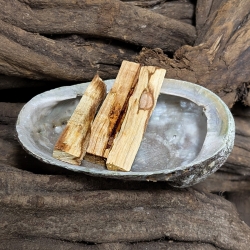
Compared to Palo Santo, white sage smells stronger, drier and less sweet. Palo Santo sits in the world of incense, cedar and citrus. White sage sits in the world of culinary herbs, conifer and menthol. Both can feel cleansing, but they do that in different ways.
Practical detail: smoke output is substantial. One well-lit bundle can smoulder for half an hour to a full hour and fills an entire room while doing so. The scent then hangs in fabrics for over a day. In a small flat or with respiratory sensitivity, that can be too much — at which point a charcoal disc with loose leaves or a lighter alternative is the sensible choice.
From Californian chaparral to Dutch shelf: the chain
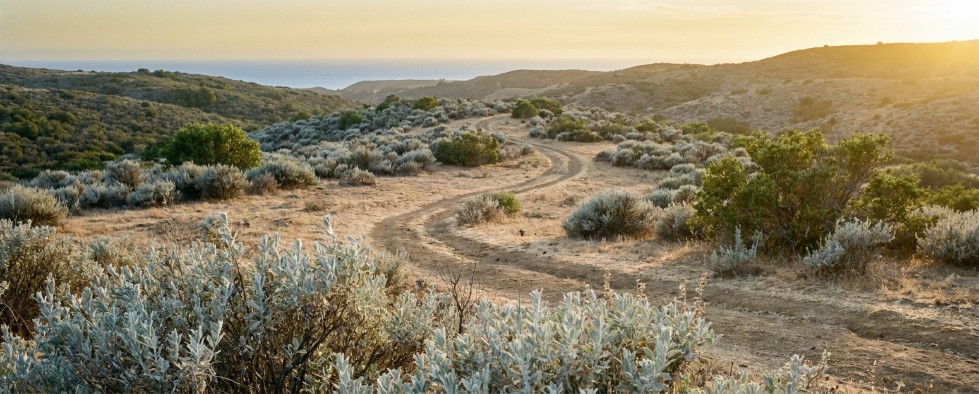
The path a white sage bundle travels before it reaches a Dutch shop is shorter than you might assume: from plant to bundle is often only two to four steps.
Step one — harvest. For wild-harvested sage this means cutting branches at a natural site, by hand, sometimes with proper permission from the landowner or protected area, sometimes without. For commercially cultivated sage this means harvest on a farm, usually in Southern California or Baja Mexico, under standard labour conditions.
Step two — drying. Cut branches are hung in airy bundles on racks, two to four weeks in a warm dry place. White sage dried too quickly or under too much humidity grows mould and becomes unusable — one of the reasons the dry climate of the southwest is so suited to it.
Step three — bundling. Dried branches are shaped into finger-thick bundles, firmly bound with natural cotton or jute. The binding craft determines how well the bundle smoulders later: too tight and oxygen can't reach the leaves, too loose and the bundle falls apart during use.
Step four — export. Bundles are shipped to Europe in cardboard boxes, often through a trader. From there they reach wholesalers and eventually the smartshop. With larger suppliers the intermediate step is usually short; with anonymous bulk importers multiple hands may have touched the product.
For scent quality, what happens in steps one and two matters most. Sage harvested too young carries less essential oil. Sage dried too hastily moulds or burns unevenly. Both are signals you recognise indirectly as a buyer — through a pale colour, a musty smell before burning, or bundles that don't hold together well.
Wild-harvested or cultivated: the choice that matters
The choice between wild-harvested and cultivated white sage is the most important practical decision for the buyer.
For a long time, wild-harvested dominated the market. The reasons: tradition (white sage was historically a craft of local wild-harvesters), price (no cultivation costs) and scent (the assumption that wild plants smell more intensely). That last assumption no longer holds — modern cultivated sage from California and Mexico reaches comparable oil concentrations.
Against wild-harvested: pressure on natural populations, unclear permits, no continuous oversight of harvest areas. For cultivated: traceable origin, manageable supply, and no impact on wild sites.
Practical signals to watch when buying:
- The seller names the source explicitly. "Cultivated from Southern California" or "wildcrafted with permission from [specific area]" are meaningful statements. "Imported from California" is not.
- Cultivated bundles tend to be more uniformly shaped than wild-harvested, because they come from plants with more uniform growth.
- Price differences are small. Cultivated is usually comparably priced or slightly higher. A suspiciously cheap bundle almost always comes from an opaque chain.
- Scent intensity doesn't differ structurally. A good cultivated bundle smells comparably strong as a good wild-harvested one. Differences sit more in drying than in origin.
For our white sage we choose origins we can account for wherever possible. Not a marketing tick-box — it directly relates to the sustainability of the wider market in the medium term.
Mindful use: the cultural context
The sourcing choice above is one side of the conversation. The other side is how you use the herb afterwards.
White sage holds a specific, sacred role for several indigenous Californian peoples — including the Chumash, Tongva, Cahuilla and Acjachemen. Tribal leaders and cultural organisations have publicly raised concern in recent years, and that concern is about two things.
First: the mass commercial harvesting that puts pressure on wild populations. Between 2018 and 2022, illegal large-scale extraction took place at multiple Californian sites. At the same time, local communities had long been pointing out that traditional harvesting practices — where plants are deliberately spared and the harvest stays limited — can no longer be maintained at commercial scale.
Second: ceremonial language and symbolism being borrowed by sellers from outside the culture. That ranges from marketing-use of traditional expressions to companies with no indigenous connection selling "indigenous ceremonial kits".
What this means for you as a user is clear and practical:
- Choose commercially cultivated white sage where possible — see the previous section.
- Use descriptive language that matches what you actually do: "freshening a room", "creating a quiet moment", "marking a ritual pause" — not borrowed ceremonial terminology you can't claim.
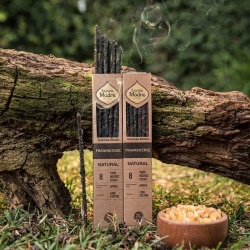
- Lavender bundles, frankincense or cultivated kitchen sage are comparably effective alternatives for anyone wanting to take the consideration further.
These aren't prescriptions. They're the practical considerations that mean your purchase contributes to a healthy long-term outlook for the plant, for the people who traditionally work with it, and for the ritual itself.
The forms white sage is sold in
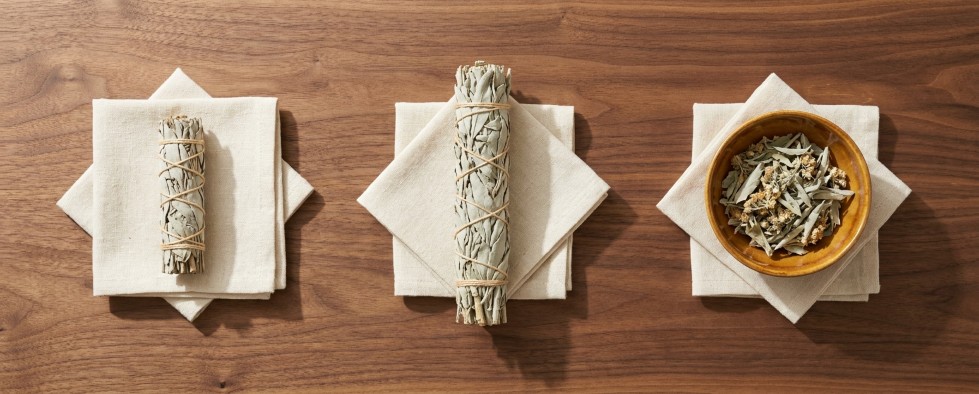
White sage is sold in three main forms. Each suits a different use.
Standard smudge sticks
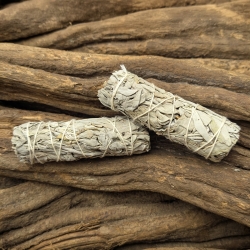
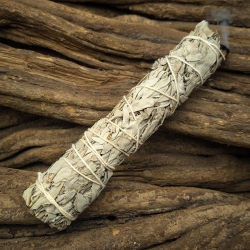
Dried branches firmly bound with natural twine into a finger-thick bundle of about ten to fifteen centimetres long. One bundle lasts six to ten sessions; you put it out after use and relight it the next time. Our white sage smudge sticks are the standard variant.
XL smudge sticks
For seated or longer sessions — bundles of twenty to thirty centimetres, thicker, smouldering longer. Suited for those who regularly walk through a whole house, or for anyone wanting a more ceremonial pace. Our XL smudge stick burns proportionally longer and delivers fuller smoke.
Loose clusters
Dried leaves and flower tops packed loose, not in a bundle. Meant to be placed on a charcoal disc or in a heat-resistant dish, similar to shredded Palo Santo. Gives more control over the amount you burn per session. Our loose clusters are practical when you want the scent but not the stick format.
The smudging ritual: how to light a bundle
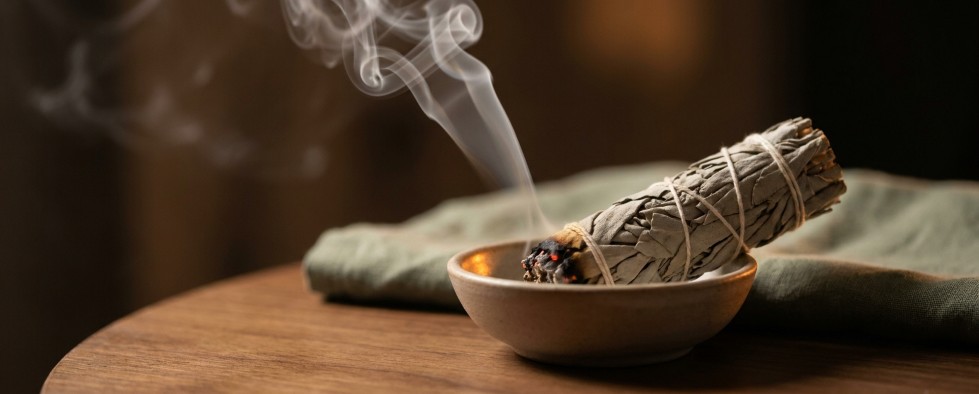
The technique is simple but precise. A well-lit bundle smoulders on its own and produces a steady stream of smoke; a poorly lit one dies out within two minutes and frustrates the whole session. Our complete smudging ritual guide covers the wider practice; the lighting technique itself is below.
-
Hold the bundle at an angle in the flame
Grip the bundle firmly by one end and hold the other end at roughly a 45-degree angle in a lighter or candle flame. An upright bundle catches less well than a tilted one.
-
Give it twenty to thirty seconds
Let the leaves genuinely catch. You'll see them colour and hear a light crackle. Too short, and the bundle goes out the moment you pull the flame away.
-
Blow it out gently
Pull the bundle back and blow the flame out softly. The tip stays glowing and releases white smoke. If it goes out again, repeat step one for a few seconds longer.
-
Hold it over a heat-resistant dish
A ceramic bowl, abalone shell or sand-filled dish is safer than your open hand. Ash falls quickly and the glowing tip is hotter than it looks.
-
Put it out in sand or a closed dish after use
Press the bundle out in sand or in a closed heat-resistant dish. Not water — that ruins the bundle for future sessions. A well-dried bundle lasts six to ten sessions.
Practical tip: if your bundle goes out within two minutes, the cause is usually moisture in the leaves. A few days in a warm dry room (a heated room, not the microwave) fixes that. A secondary cause is binding that's too tight — somewhat looser bundles smoulder longer.
When white sage isn't the right choice
The situations below are where another cleansing tool is more practical or more culturally appropriate.
| Situation |
Better alternative |
| A small flat with poor ventilation |
Palo Santo — much less smoke, shorter duration |
| Respiratory sensitivity or asthma in the household |
Essential oil diffuser, or no burning at all |
| A room with pets, particularly birds |
No open burning; cold essential oil diffuser |
| A brief mood moment before meditating |
Palo Santo or an incense stick — less smoke, shorter footprint |
| Need for ceremonial ritual without cultural weight |
Frankincense or myrrh — centuries-old use across non-indigenous traditions |
| Uncertainty over respectful use |
Lavender bundles or cultivated kitchen sage — comparable effect, no borrowed tradition |
For anyone wanting to work with white sage but looking for alternatives with less cultural weight: Palo Santo is the most common choice. For anyone wanting to take it further: cultivated kitchen sage (Salvia officinalis) burns similarly, smells herbal, and carries no sacred ceremonial tradition you'd need to account for.
Storage and shelf life
White sage is dried plant material — relatively stable, but sensitive to moisture and other scents.
- Keep it dry. A sealed glass jar or a tin is ideal. An ordinary kitchen cupboard works fine, as long as it's not right next to a kettle or steaming pot.
- Dark is nice but not critical. Direct sunlight slowly evaporates the essential oils. A drawer is better than a windowsill.
- Away from other scents. White sage absorbs nearby aromas readily. Don't store next to coffee, spices or essential oils — the neighbouring scent will seep in.
- Shelf life runs in years. Stored well, the scent stays stable for years. If a bundle smells weaker after a long time, rolling the surface lightly between your fingers releases fresh essential oils.
Which form suits whom?
A short practical ordering of the three main forms:
- Standard smudge sticks — best choice for occasional house resets or short sessions. One bundle per household per year is typical.
- XL smudge sticks — for regular seated sessions, or for those who like to use the same bundle for several months. Longer smouldering, fuller smoke output.
- Loose clusters — for those who prefer working with a charcoal disc, or who want to combine the scent with other resins (frankincense, myrrh). More control, less volume per session.
White sage is more than an aromatic product. Less than a sacred ceremony. Somewhere in between — in the conscious choice of a good bundle, in the twenty seconds it takes to catch the flame, in the smoke moving across your room — sits the most valuable thing the herb offers: a brief ritual pause in which a space, and with it your own attention, is reset for a moment.
Why Next Level Smart?
- More than 10 years of experience in ethnobotanical products — not suppliers who just hopped on the smudging trend
- Three forms in stock — standard sticks, XL bundles and loose clusters, so you can pick what fits the situation
- Transparent on sourcing — cultivated where possible, and always clear about origin
- Discreet shipping across the Netherlands and Europe
Further reading
For the practical performance of the smudging ritual itself — not just the herb, but what you do with it — our complete smudging ritual guide is the natural next step. For anyone wanting to compare white sage with its South American counterpart: our Palo Santo guide. And for anyone wanting to explore the wider incense landscape: the incense guide.
What is white sage actually used for?
For two things that flow into one another. Practically: giving a room a new, herbal, fresh layer of scent that largely overtakes whatever was hanging there. Ritually: marking a brief pause — before meditation, after a difficult conversation, or as a symbolic reset during a move or a new life chapter. For most users, the second follows directly from the first.
How long does a smudge stick burn?
One lighting gives fifteen to thirty minutes of smouldering. But the bundle is reusable. An average smudge stick lasts six to ten sessions before it's spent. Reckon on about two hours of effective burn time per bundle, spread across multiple sessions.
What's the difference between common kitchen sage and white sage?
Different species in the same family. Kitchen sage (Salvia officinalis) has smaller, dark-green leaves and is used for cooking. White sage has longer, silvery-grey leaves, a much more intense herbal scent, and is used for smudging. You can burn kitchen sage too, but the scent is much less pronounced — and for some people, that makes it an ethically acceptable alternative.
Is white sage endangered?
Not officially on the IUCN list. Wild populations are under pressure from over-harvesting, especially in southern California, where illegal large-scale extraction took place at multiple sites between 2018 and 2022. Responsible sourcing — preferably from commercial cultivation — is the difference between a product with a future and one without.
Is it appropriate for non-indigenous people to use white sage?
No universal yes or no. The plant itself is freely available and not protected. What tribal voices do ask is two things: choose cultivated sage where possible to ease pressure on wild populations, and don't use ceremonial language or symbolism tied specifically to their traditions. For most users, that's the core: respect for the source, care with borrowed elements.
Is it okay to burn white sage indoors, including in a flat?
Yes, but the smoke output is significant — much more than a Palo Santo stick or a regular incense stick. Make sure to ventilate, an open window or draught. Watch the smoke alarm, especially if it's directly above the smudging spot. For respiratory conditions or young children: choose Palo Santo or a lighter alternative.
How do I recognise a good bundle?
Three signals. One: weight. A well-dried bundle with proper oil content is light but resilient — not papery. Two: colour. A green-silvery bundle with intact leaves, no pale-grey or browned sections. Three: scent before burning. A good bundle gives off a light herbal scent on your fingers when you pick it up. A bundle that smells of nothing, or musty, is poorly dried or too old.
Is white sage safe around pets?
The smoke is harmless to most animals in small amounts, but cats, dogs and especially birds have more sensitive airways than humans. Burn it preferably in a room where the animal isn't present, and open a window. For birds or small pets like guinea pigs: don't burn it in the same space.
Does white sage work as an insect repellent?
Anecdotally yes, particularly against mosquitoes and small flies. The combination of eucalyptol and α-pinene has a mildly repellent effect on a number of insect species. Scientific backing is limited, but many people notice the effect during summer evenings on a garden or balcony.
Can you grow white sage in the Netherlands?
Possible, but Dutch conditions are not ideal. White sage wants plenty of sun, poor soil and little rain — difficult to achieve in our climate. Surviving a few years in a large pot on a sunny spot often works, but the essential oils never reach the concentration of plants from California or Mexico. For practical scent quality, Californian or Mexican origin remains the right choice.
Caution: Always place burning or smouldering material in a heat-resistant dish. In case of respiratory conditions, pregnancy, or use in a room with pets or young children: ventilate well or burn in a separate space.
Last updated: June 2026 | Next Level Smart