Blog navigation

Latest posts

Party Pills Comparison: Happy Caps vs DNX Pills

Twenty party pills in the shop and no idea which to pick? This comparison puts Happy Caps, DNX and the new Party-E...

Read More
Liquid Spore Cultures vs Spore Prints: Which Should You Choose?

Liquid spore cultures and spore prints are the two main ways to start a mushroom cultivation project. This guide...

Read More
Incense Guide: Which Type of Incense Is Right for You?

With over 60 types of incense in our collection, choosing the right one takes a bit of knowledge. This guide compares...

Read More
Kuripe vs Tepi: Which Rapé Applicator Suits You?

Kuripe or tepi? These are the two tools used to administer rapé, and choosing between them changes the experience...

Read More

The Kratom Problem


Kratom quality doesn't just depend on genetics or how it's grown and harvested. One of the most critical moments comes after: drying. And that's where things go wrong with a lot of kratom.

Kratom drying facility in Borneo


Why Alkaloids Matter So Much

Kratom leaves contain over 40 different alkaloids. These are the organic compounds that determine how kratom works. The two most important ones are mitragynine and 7-hydroxymitragynine. Mitragynine often makes up about 66% of the total alkaloid content, while 7-hydroxymitragynine is more potent but occurs in much smaller amounts.

These alkaloids are fragile. UV light breaks them down, and high temperatures damage their structure. Humidity affects their stability. Even the way leaves are handled during drying makes a difference in what ultimately remains.

You can start with leaves from healthy, mature trees, but if they dry incorrectly, they'll lose some of their potency. The drying process determines what's left of those alkaloids.

The Hygiene Problem

Traditional kratom drying method in Indonesia

In Indonesia, almost everything gets sun-dried. That includes cacao, rice, vanilla, cloves, and kratom too. This method has been embedded in the culture for centuries and gets passed down through generations.

For many crops, it works fine. But with kratom, there are two problems with this approach: hygiene and UV radiation.

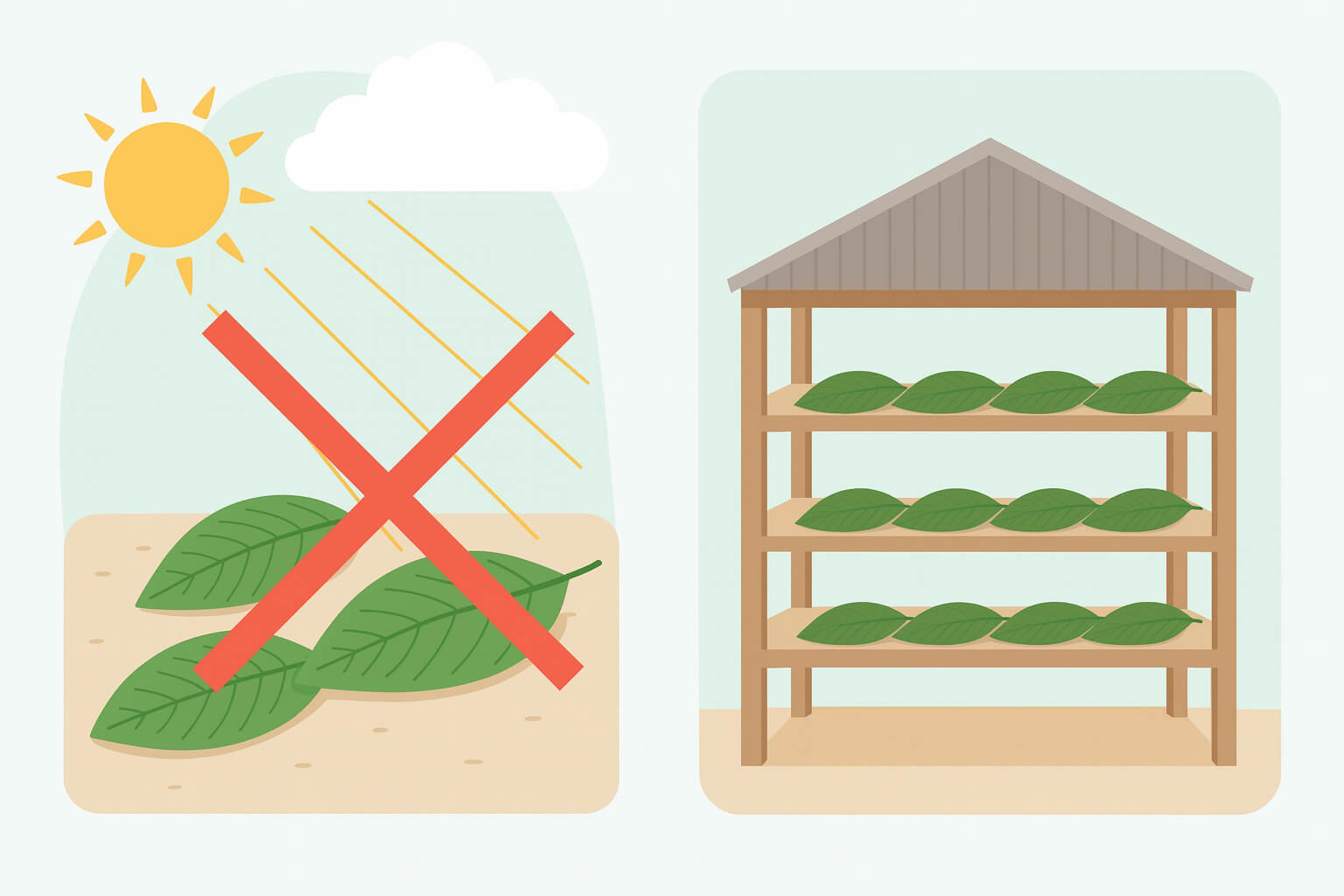
A lot of kratom dries on plastic tarps by the roadside. Cars and motorbikes pass by. Exhaust fumes, diesel smoke, and dust settle on the leaves. In villages, the tarps often sit right on the ground – sometimes people walk across them, sometimes animals do. Chickens peck at them, dogs sniff around.

It's not that people do this on purpose. It's just how things have always been done. But for a product like kratom, these aren't the conditions you'd want.

Then there's the UV problem. Direct sunlight – the same sunlight that helps preserve cloves and cacao – degrades mitragynine. The tropical sun breaks down the molecular structure of the alkaloids. What works for other crops actually works against kratom.

A lot of the kratom you find in Europe has unfortunately been dried this way. There's a better way.

Why We Work Differently

Next Level kratom drying facility

We could have just bought kratom from wholesalers like many other shops do. Accept what's offered, don't ask too many questions, and focus mainly on price. But once you've seen how most kratom gets dried – on dusty tarps next to busy roads – you know there has to be a better way.

That's why we built our own drying facilities in Putussibau. Putussibau sits at the headwaters of the Kapuas River in Kalimantan, the Indonesian part of Borneo. It's one of the few places where kratom grows naturally. The trees stand in gardens and the surrounding jungle. Some grow fifteen or twenty meters tall.

The kratom we dry in our facility comes from two sources: wild kratom from the jungle (far from roads, growing in pristine environments) and controlled plantations where we work with local farmers. Once the leaves are harvested, they go to the facility.

Multi-level drying racks in kratom facility

We do three things differently:

Special drying racks in a controlled environment. All leaves sit on elevated wooden racks, far from the ground. No contact with dirt, no foot traffic, no animals. Air circulates from below and above, creating even drying times. Contamination becomes physically impossible.

Clean mesh. Each leaf sits on food-grade mesh. Not on plastic, not on bamboo mats, not on concrete. The mesh lets air through, so moisture escapes evenly without getting trapped. Between batches, we clean the material.

Controlled light. The structure has a corrugated roof with ventilation, but direct sunlight doesn't reach the leaves. They dry in a bright, ventilated space without UV rays breaking down the alkaloids. This is one of the biggest advantages: mitragynine stays stable and 7-hydroxymitragynine doesn't get lost.

Inside this space, temperature and humidity are also more stable. No scorching heat during the day and humid nights. No extreme fluctuations. Just steady, controlled conditions where leaves dry properly while the active compounds stay intact.

What You Get

Kratom dried this way retains more of what the plant naturally contains. The alkaloid profile stays intact, batch-to-batch consistency is higher, and there's no contamination from outside.

That doesn't mean all other kratom is automatically bad. But it does explain why there can be so much difference between one product and another. The drying process simply determines a large part of the quality.

This approach requires more investment, more time, and more commitment. But it also delivers kratom as it should be: clean, fresh, and with the full alkaloid profile that comes with it.

View our kratom collection


More questions about our drying process, our plantations, or how we source? Email info@nextlevelsmart.nl

 
Posted in: All posts, Smartshop, Kratom
Lex Johnson is a self-taught herbalist, language freak, musician and one of the writers behind the Next Level blog. His curiosity runs wide — from the differences between Criollo and Trinitario cacao to the latest psilocybin research. That same curiosity shows in the range of his writing. Lex covers everything from ceremonial cacao and kanna to magic mushrooms, salvia divinorum, kambo, party pills, healing herbs and product deep dives. In addition to a journalism foundation certificate, he holds a Bachelor of Fine Arts.
Loading...