Cannabis contains far more than THC. More than 120 cannabinoids have now been identified in the plant, alongside roughly 200 terpenes and hundreds of flavonoids. Each compound has its own action, its own receptor profile and its own legal status. Over the past decade scientific research into these compounds has accelerated sharply — shifting the conversation about cannabis from "high or not" to a richer field of pharmacology, terpenes and spectrum choice.
In this guide we lay out every cannabinoid that matters in practice: from the famous big four (THC, CBD, CBG, CBN) to semi-synthetic variants like HHC and Delta-8, plus the cannabinoid acids the plant produces before decarboxylation. We cover how the endocannabinoid system works in your body, why terpenes do more than smell, and what the entourage effect means for choosing cannabis products.
What are cannabinoids?
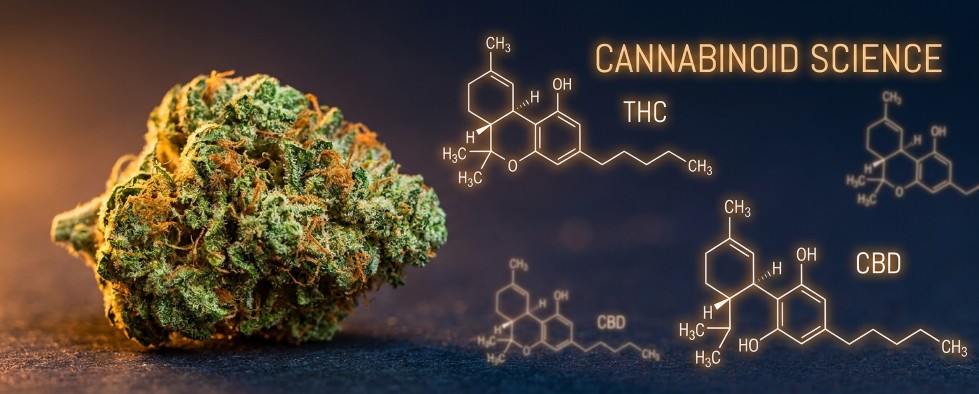
Cannabinoids are a group of chemical compounds that bind to cannabinoid receptors in the body. There are three main categories:
Phytocannabinoids — produced by plants. Cannabis is the best-known source but not the only one — echinacea, helichrysum and some liverworts also produce compounds that act on cannabinoid receptors. In Cannabis sativa more than 120 different phytocannabinoids have been identified. The plant produces them in glandular trichomes — those crystalline structures on the flower — as secondary metabolites.
Endocannabinoids — made by the body itself. The two most important are anandamide (from the Sanskrit ananda, joy) and 2-arachidonoylglycerol (2-AG). They are produced "on demand" the moment the nervous system needs them, and are broken down relatively quickly.
Synthetic cannabinoids — produced in a laboratory. Some are legitimate research tools (JWH-018, WIN 55,212-2), others are sold illegally as "spice". A separate category are semi-synthetic cannabinoids, where a natural cannabinoid is chemically modified — such as HHC and Delta-8 THC. We come back to these later.
The endocannabinoid system: how it works in your body
The endocannabinoid system (ECS) was discovered in the 1990s, ironically as a direct response to research into how cannabis works. In 1988 Allyn Howlett and colleagues identified the first cannabinoid receptor in rat brain tissue (Devane et al., Mol Pharmacol 1988). In 1992 Raphael Mechoulam isolated the first endogenous cannabinoid — anandamide (Devane et al., Science 1992).
The ECS regulates what pharmacologists call homeostasis: keeping various bodily functions in balance. Sleep, mood, appetite, pain perception, stress response, memory, immune function — the ECS plays a part in all of them. Not as a lead actor, but as a brake and accelerator that fine-tunes other systems.

Two receptors are central:
CB1 receptors — primarily in the central nervous system (brain, spinal cord). Highest density in the basal ganglia, cerebellum, hippocampus and cortex. Responsible for the psychoactive effects of THC. CB1 activation explains why THC affects coordination, memory, appetite and pain perception.
CB2 receptors — primarily in immune cells and peripheral tissue (spleen, tonsils, gut). No psychoactive effects on activation. Central role in inflammation regulation.
The two key endogenous cannabinoids:
- Anandamide (AEA) — binds to CB1 and CB2, structurally similar to THC. Broken down rapidly by the enzyme FAAH (fatty acid amide hydrolase).
- 2-arachidonoylglycerol (2-AG) — present in much higher concentrations than anandamide. Broken down by MAGL (monoacylglycerol lipase).
Phytocannabinoids like THC and CBD work because they're chemically similar enough to these endocannabinoids to activate the same receptors — or, in CBD's case, by inhibiting the breakdown of endocannabinoids and amplifying the endogenous signal.
The major cannabinoids: an overview
| Cannabinoid |
Receptor profile |
Psychoactive |
Known for |
NL status 2026 |
| THC (Δ9) |
CB1 + CB2 partial agonist |
Yes, strong |
Mood, appetite, pain |
Opium Act (tolerated in coffeeshops) |
| CBD |
Allosteric modulator, FAAH inhibitor, 5-HT1A, TRPV1 |
No |
Inflammation, epilepsy, anxiety |
Legal, Novel Food on ingestion |
| CBG |
Weak CB1/CB2, α2-adrenergic agonist |
No |
Antibacterial, glaucoma (research) |
Legal, Novel Food |
| CBN |
Weak CB1, stronger CB2 |
Mild (~¼ of THC) |
Associated with sleep |
Legal, Novel Food |
THC — Delta-9-tetrahydrocannabinol
The best-known phytocannabinoid, and the compound that gives cannabis its characteristic psychoactive effect. Discovered in 1964 by Raphael Mechoulam. THC is a partial agonist of both CB1 and CB2, with stronger affinity for CB1. The psychoactivity stems from CB1 activation in the brain.
In the plant THC exists as THCA — the acidic precursor. THCA itself is not psychoactive. Only through heating (decarboxylation) or prolonged storage is THCA converted to THC.
Beyond the well-known effects on mood, perception and appetite, science also investigates THC for pain, chemotherapy-induced nausea, multiple sclerosis spasticity and sleep. Clinical applications exist in registered medicines like dronabinol and nabilone, and in prescription medicinal cannabis.
CBD — Cannabidiol
The other big name, and the cannabinoid the cosmetics and supplements industry has been built on since 2015. CBD isn't a typical CB1 agonist; its affinity for CB1 and CB2 is low. Instead it works through a notably complex pharmacological mechanism:
- Allosteric modulation of CB1 (changing how the receptor responds to other compounds)
- Inhibition of FAAH, keeping anandamide active longer
- Activation of TRPV1 (pain sensor receptor)
- Activation of 5-HT1A (serotonin receptor)
- Activation of PPAR-γ (nuclear receptor involved in metabolism and inflammation)
Net result: CBD has no psychoactive effect but is actively researched for anxiety, inflammation, epilepsy and sleep. The only FDA-approved cannabinoid medicine — Epidiolex — is CBD-based and is prescribed for two rare childhood epilepsies (Lennox-Gastaut and Dravet syndromes).
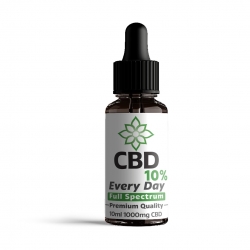
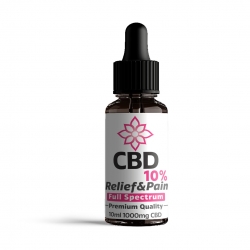
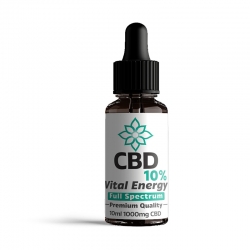
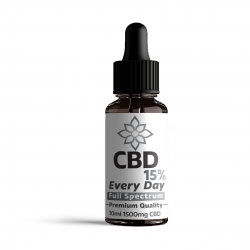
In our range you'll find full spectrum CBD oil in various strengths: CBD Oil 10% Vital Energy, CBD Oil 10% Relief & Pain, CBD Oil 10% Every Day and the stronger CBD Oil 15%.
CBG — Cannabigerol, mother of all cannabinoids
CBG is often called "the mother cannabinoid" because CBGA — its acidic form — is the chemical precursor to THCA, CBDA and CBCA. The plant produces CBGA first, and specific enzymes then convert it into the other acids. In most commercial cannabis strains only 1-2% CBG remains by harvest; special CBG-dominant cultivars are bred to reach higher percentages.
CBG binds to CB1 and CB2 with low affinity, but is a strong agonist of α2-adrenergic receptors and an inhibitor of 5-HT1A. Research is investigating applications in glaucoma (lowering eye pressure), inflammatory bowel disease, neuroprotection, and as an antibacterial — in vitro studies show activity against MRSA. Clinical evidence is still early but the field is growing rapidly.
CBN — Cannabinol
CBN forms through oxidation of THC. Older cannabis therefore contains more CBN than fresh — a process accelerated by heat, light and air exposure. CBN is mildly psychoactive: roughly a quarter of THC's potency. In the wellness industry CBN is heavily promoted as "the sleep cannabinoid", but scientifically that narrative remains weakly supported.
A frequently cited 1975 study by Karniol found synergistic sedation between THC and CBN — but that says more about the combination than about CBN alone. Modern research is still hunting for the exact mechanism. What does hold up in practice: aged cannabis (with more CBN) is reported by users as more sedating than fresh harvest. Whether that's down to CBN itself or terpene degradation is an open question.
Minor cannabinoids: CBC, THCV, CBDV, THCP
Alongside the major four there are dozens of "minor" cannabinoids occurring at low concentrations or only recently discovered:
CBC (cannabichromene) — derived from CBCA. Binds weakly to CB1 and CB2 but is a strong activator of TRPA1 and TRPV1 (pain and temperature receptors). Investigated for pain, neuroprotection and mood. CBC and CBD appear to enhance each other synergistically in inflammation studies in animals.
THCV (tetrahydrocannabivarin) — a propyl analogue of THC (shorter side chain). At low doses THCV actually acts as a CB1 antagonist — it blocks THC's effects. At higher doses it shifts to agonist and becomes mildly psychoactive. Associated with appetite suppression — hence its nickname "diet weed" in English sources. Found in higher concentrations in African and Asian landrace strains like Durban Poison.
CBDV (cannabidivarin) — propyl analogue of CBD. Researched for epilepsy and autism spectrum conditions. Non-psychoactive like CBD.
THCP (tetrahydrocannabiphorol) — discovered in 2019 by Citti and colleagues (Citti et al., Sci Rep 2019). A heptyl analogue of THC with a longer side chain. Binding affinity for CB1 is more than 30× stronger than THC. Occurs in very low concentrations in the plant — possibly an explanation for the variable potency of apparently similar chemovars.
CBDP (cannabidiphorol) — heptyl analogue of CBD, discovered in parallel by the same group. Activity largely unknown.
Semi-synthetic cannabinoids: HHC, Delta-8 and THC-O
In recent years compounds have appeared on the market that don't occur naturally in the plant (or only at trace levels) but are produced via chemical conversion from CBD or THC. Three main variants:
HHC (hexahydrocannabinol) — a hydrogenated form of THC where the double bond on the cyclohexenyl ring is saturated with hydrogen. First synthesised by Roger Adams in 1944, but only appeared on the consumer market around 2020 via a chain that extracts CBD from hemp, converts it to THC, and then hydrogenates it to HHC. The effect is somewhat THC-like but weaker and with a different metabolic profile. In the Netherlands HHC has been listed on the Opium Act schedule since 2023 and is therefore prohibited. Next Level Smart does not sell HHC products. For the broader HHC debate see our article HHC vs THC: everything about hexahydrocannabinol.
Delta-8 THC — an isomer of Delta-9 THC with the double bond shifted from position 9 to position 8 on the cyclohexyl ring. Occurs naturally in very low concentrations; commercial Delta-8 is almost always synthesised from CBD through acid-catalysed isomerisation. About two-thirds the potency of Delta-9 THC. Legal status varies across the EU; in the Netherlands the same enforcement logic applies as with HHC.
THC-O (THC-O-acetate) — an acetate ester of THC, not naturally present in the plant. Claimed to be more potent than Delta-9 THC. Safety data is limited; reported EVALI-style lung inflammation cases with vape use have drawn regulatory attention in the United States.
Cannabinoid acids and decarboxylation
A crucial point for anyone wanting to understand the chemistry: the living plant doesn't produce THC, it produces THCA. Not CBD, but CBDA. These acidic precursors carry an extra carboxyl group (-COOH) on the molecule.
Decarboxylation is the loss of that carboxyl group — it escapes as CO2. The process happens through:
- Heat — at around 100-110 °C slowly, at 120-140 °C quickly
- Smoking — instantaneous through combustion heat
- Vaporising — automatic once the flower exceeds 100 °C
- Aging — slow over weeks to months, even at room temperature
Unprocessed raw cannabis contains almost exclusively the acids. Eating raw leaf gives no psychoactive effect — only after decarboxylation does THCA convert to THC. The acidic forms do have their own activity, though — THCA is being researched for anti-inflammatory effects, CBDA for anti-emetic effects. An emerging research field that has gained increasing attention in recent years.
Terpenes: aroma, flavour and pharmacology
Alongside cannabinoids, cannabis produces around 200 different terpenes — volatile aromatic compounds that also occur in lemon, pine, lavender and hops. Terpenes are responsible for how a strain smells and tastes, but they do more than that: they have their own pharmacological activity and interact with cannabinoids.
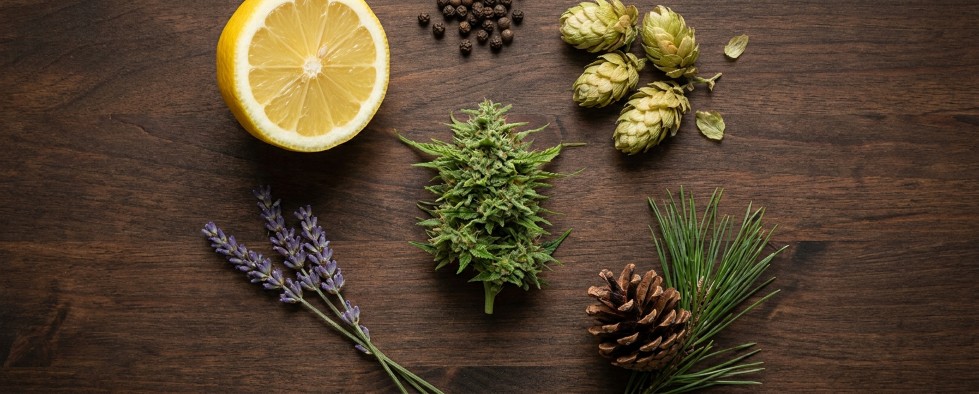
The eight most relevant cannabis terpenes:
| Terpene |
Aroma |
Also found in |
Known for |
| Myrcene |
Earthy, herbal, musky |
Hops, mango, thyme |
Sedation, "indica feel" |
| Limonene |
Citrus, freshness |
Citrus peel |
Mood, stress reduction |
| Pinene (α/β) |
Pine, resin |
Conifers, rosemary |
Alertness, memory |
| Linalool |
Floral, lavender |
Lavender, coriander |
Calming, sleep |
| Caryophyllene (β-) |
Peppery, clove |
Black pepper, clove |
Binds to CB2 receptor |
| Humulene |
Earthy, hoppy |
Hops, ginger |
Appetite suppression |
| Terpinolene |
Complex, citrus-herbal |
Tea tree, lemongrass |
Cerebral effect |
| Ocimene |
Sweet, herbal |
Basil, peppermint |
Anti-microbial (research) |
One stand-out: caryophyllene is the only known terpene that directly binds to CB2 receptors. That technically makes it more a dietary cannabinoid than an ordinary terpene — a unique position it earned in 2008 after a key publication by Gertsch and colleagues.
The entourage effect: why the whole plant works
The term "entourage effect" was introduced in 1998 by Mechoulam and Ben-Shabat, and expanded in an influential 2011 review article by Ethan Russo (Russo, Br J Pharmacol 2011). The core idea: the pharmacological action of a cannabis extract is more than the sum of the isolated cannabinoids — terpenes and minor cannabinoids modify each other's effects through synergistic and antagonistic interactions.
Concrete examples from Russo's review:
- CBD reduces the anxiety side-effects of high-dose THC
- Myrcene enhances the sedative effect of CBN
- Limonene and CBD appear to additively support stress reduction
- Pinene counteracts the short-term memory effect of THC
This is why pure THC isolate (the prescription drug dronabinol, for example) clinically behaves differently from full-spectrum cannabis containing the same amount of THC. Patients consistently report that the plant works better than the pill — and the entourage effect hypothesis offers a mechanistic framework.
Not all researchers are convinced: a counter-current argues that many claims rest on anecdotal reports and that controlled clinical studies are scarce. The debate continues — but in the CBD products market "full spectrum" now carries a clear price premium over isolate.
Spectrum choice: full spectrum, broad spectrum or isolate
For CBD products you'll see three spectrum designations on packaging — directly applicable to the choice between our CBD oils:
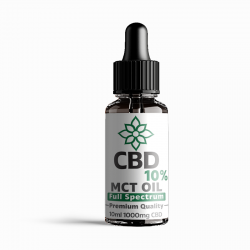
Full spectrum — contains all naturally occurring cannabinoids from the hemp plant, including up to 0.2% THC (EU limit for industrial hemp) plus terpenes and flavonoids. Maximum entourage effect. Our CBD Oil 10% Vital Energy, CBD Oil 10% Relief & Pain, CBD Oil 10% Every Day and the stronger CBD Oil 15% are all full spectrum CO2 extracts. The CBD MCT Oil 10% uses an MCT carrier oil for improved absorption.
Broad spectrum — like full spectrum but with the THC removed via an additional purification step. No psychoactivity, but you still get terpenes and minor cannabinoids. Suitable for anyone wanting to avoid THC entirely (e.g. for drug-testing-sensitive jobs) while still benefiting from the entourage effect.
CBD isolate — 99%+ pure CBD, all other cannabinoids and terpenes removed. No entourage effect, but full dosage control and zero THC. Flavourless — handy for use in recipes.
Which spectrum fits depends on the goal:
- Maximum therapeutic effect → full spectrum
- Avoid THC completely, still want synergy → broad spectrum
- Precise dosing, predictable effect, neutral flavour → isolate
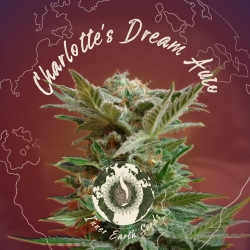
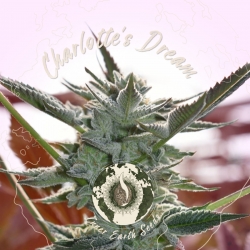
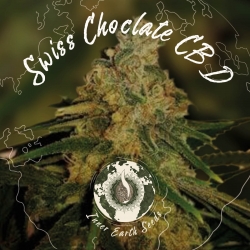
For growers preferring to cultivate rather than buy oil: our CBD seed selection within Inner Earth Seeds has three options: Charlotte's Dream (CBD) — feminized photoperiod with 12-16% CBD and 0.3-0.6% THC, Charlotte's Dream Auto (CBD) with 18-22% CBD, and Swiss Chocolate CBD with 8-15% CBD and a chocolate-coffee profile.
Legal status per cannabinoid in the Netherlands (May 2026)
| Cannabinoid |
Status |
Notes |
| THC (Δ9) |
Controlled |
Opium Act schedule II as part of cannabis preparations. Sale tolerated in coffeeshops under conditions. |
| CBD |
Legal (Novel Food) |
Cosmetic and external use fine. As food supplement falls under Novel Food Regulation — formal approval still pending. |
| CBG |
Legal (Novel Food) |
Same regulatory framework as CBD. |
| CBN |
Legal (Novel Food) |
Same; no specific regulation yet. |
| CBC, THCV, CBDV |
Legal (Novel Food) |
Not on Opium Act schedule; subject to food regulation when ingested. |
| HHC |
Banned |
Added to Opium Act schedule II in 2023. Production, trade and possession criminal. |
| Delta-8 THC |
Legal grey area |
Not specifically scheduled but often enforced as a THC analogue. |
| THC-O |
Legal grey area |
Same. Safety data limited. |
| THCP, CBDP |
Unclassified |
Too recent for specific Dutch regulation. |
For the practical context of how Novel Food is enforced in the Netherlands, see our complete indoor growing guide and outdoor growing guide where the legal framework around home cultivation is covered in depth.
Why Next Level Smart?
- More than 10 years of experience in cannabinoid products and grow knowledge
- Full spectrum CBD oils from CO2 extraction — no solvent residues
- Inner Earth Seeds CBD genetics with measured CBD percentages per batch
- Clear regulatory communication — we track Novel Food, NVWA and EU developments closely
- Discreet shipping within the Netherlands and across Europe
Frequently asked questions about cannabinoids
What exactly are cannabinoids?
Cannabinoids are chemical compounds that bind to cannabinoid receptors in the body. There are three types: phytocannabinoids (plant-produced, primarily from cannabis), endocannabinoids (produced by the body itself, like anandamide and 2-AG), and synthetic cannabinoids (lab-made).
How does the endocannabinoid system work?
The endocannabinoid system (ECS) is a network of CB1 and CB2 receptors plus endogenous cannabinoids that regulates many bodily functions: sleep, mood, appetite, pain perception, immune function. It acts as a homeostatic system — a brake and accelerator on other systems. Discovered in the 1990s in response to cannabis research.
What is the difference between CBD and THC?
Both are phytocannabinoids from cannabis but work very differently. THC binds directly and strongly to CB1 receptors in the brain — that's where the psychoactive effect comes from. CBD barely binds to CB1 or CB2 but works through allosteric modulation, FAAH inhibition and activation of TRPV1 and 5-HT1A. As a result CBD is not psychoactive.
Is CBD psychoactive?
No. CBD has no noticeable psychoactive effect at typical doses. It barely binds to CB1 — the receptor responsible for the THC "high". CBD is sometimes described as "non-intoxicating": it can affect mood and feeling, but it doesn't make you stoned.
What is CBG and what does it do?
CBG (cannabigerol) is "the mother cannabinoid" — its acidic form CBGA is the chemical precursor to THCA, CBDA and CBCA in the plant. CBG itself binds weakly to CB1/CB2 but is strongly active at α2-adrenergic receptors. Researched for glaucoma, antibacterial activity and gut health. Clinical evidence is still early.
Does CBN really help with sleep?
The wellness industry claims it strongly, but scientific evidence is still thin. CBN forms through oxidation of THC and is mildly psychoactive (~¼ of THC potency). Aged cannabis with more CBN is often reported as more sedating, but whether that's down to CBN itself or to terpene degradation and synergy with residual THC has not been settled.
Is HHC still legal in the Netherlands in 2026?
No. HHC has been on the Dutch Opium Act schedule II since 2023 and is therefore illegal for production, trade and possession. Next Level Smart does not sell HHC products. Other European countries handle this differently — in some HHC is still tolerated, in others also banned.
What is Delta-8 THC?
Delta-8 THC is an isomer of the better-known Delta-9 THC, with the double bond shifted from position 9 to position 8 on the cyclohexyl ring. Occurs naturally in very low concentrations; commercial Delta-8 is almost always synthesised from CBD. About two-thirds the potency of Delta-9 THC. Legal status in the Netherlands is a grey area.
What are terpenes in cannabis?
Terpenes are volatile aromatic compounds responsible for the smell and flavour of cannabis, and also found in many other plants (citrus, pine, lavender, hops). Cannabis produces about 200 different terpenes. Key examples: myrcene (earthy, sedative), limonene (citrus, mood), pinene (pine, alertness), linalool (lavender, calming), caryophyllene (peppery, binds directly to CB2 receptors).
What is the entourage effect?
The hypothesis that the pharmacological action of a cannabis extract is more than the sum of its isolated cannabinoids — terpenes and minor cannabinoids modify each other's effects through synergistic and antagonistic interactions. First described in 1998 by Mechoulam and Ben-Shabat; elaborated by Ethan Russo in 2011. Explains why full spectrum extracts often behave clinically differently from pure THC isolate.
What is full spectrum CBD?
Full spectrum CBD contains all naturally occurring cannabinoids from hemp — including up to 0.2% THC (EU limit for industrial hemp) plus terpenes and flavonoids. The opposite is CBD isolate (99%+ pure CBD). Broad spectrum is the middle option: everything except THC. Our CBD oils are full spectrum CO2 extracts.
Which cannabinoid is best for sleep?
Science hasn't settled the question. CBN is anecdotally favoured but the evidence is thin. THC has sedative effects but disrupts REM sleep. CBD is researched for sleep-onset problems via anxiety reduction. In practice the combination of CBD with sedative terpenes like myrcene and linalool (often in indica-leaning strains or full spectrum extracts) seems more effective than any isolated cannabinoid alone.
What are THCA and CBDA?
The acidic precursors of THC and CBD. The living plant produces these acids; only through heating (decarboxylation) do they convert into the active forms. THCA is not psychoactive — only after decarboxylation does it activate into THC. The same logic applies for CBDA → CBD. The acids themselves do have their own activity — THCA is being researched for anti-inflammatory effects, CBDA for anti-emetic effects.
Does the body make its own cannabinoids?
Yes, in part. The two key endogenous cannabinoids are anandamide (from the Sanskrit for "joy") and 2-arachidonoylglycerol (2-AG). They are produced "on demand" by the nervous system and bind to the same CB1 and CB2 receptors as THC and CBD. Breakdown is handled by FAAH (for anandamide) and MAGL (for 2-AG).
Which cannabinoids are legal in the Netherlands?
CBD, CBG, CBN, CBC, THCV and CBDV are legal in the Netherlands but fall under the Novel Food Regulation when ingested. THC sits under the Opium Act (tolerated through coffeeshops). HHC has been on the Opium Act schedule since 2023 and is banned. Delta-8 THC and THC-O are legal grey areas but in practice are often enforced as THC analogues. THCP is too recent for specific regulation.
Last update: May 2026 | Next Level Smart