DMT is a strikingly unusual molecule. It sits in hundreds of plant species from the Amazon to Australia, in small amounts in mammals including humans, and as a pure substance it's strictly prohibited in the Netherlands. Over the past five years it has stepped out of an academic niche and an Amazonian tradition and into the cultural mainstream — discussed on podcasts with millions of listeners, studied in clinical trials in London and San Francisco, and the subject of thousands of YouTube discussions a month.
What it is, how it works, where it occurs, and what science has learned about it — that is the subject of this guide. An honest explanation of a molecule that keeps moving closer to the cultural centre.
What DMT actually is
DMT stands for N,N-dimethyltryptamine. It's an organic compound from the tryptamine family, a group of molecules structurally related to serotonin — the neurotransmitter in your own brain that regulates mood, sleep, appetite and more.
The molecule is small, simple, and chemically not especially complex. What makes it remarkable is what happens when it reaches the nervous system in sufficient quantity: a temporary, often overwhelming reorganisation of perception, thought and sense of self that ranks among the most intense experiences a person can report. Notably, the body breaks free DMT down extremely quickly, making it one of the shortest-acting compounds in its class. It is that combination of intensity and brevity that makes the molecule so scientifically intriguing.
The compound has existed in nature for as long as plants and animals have. People have been using DMT-containing plants ritually for demonstrably thousands of years — Bolivian archaeological finds of ritual tubes with DMT residue have been dated to roughly a thousand years old.
The molecule: from indole ring to serotonin family
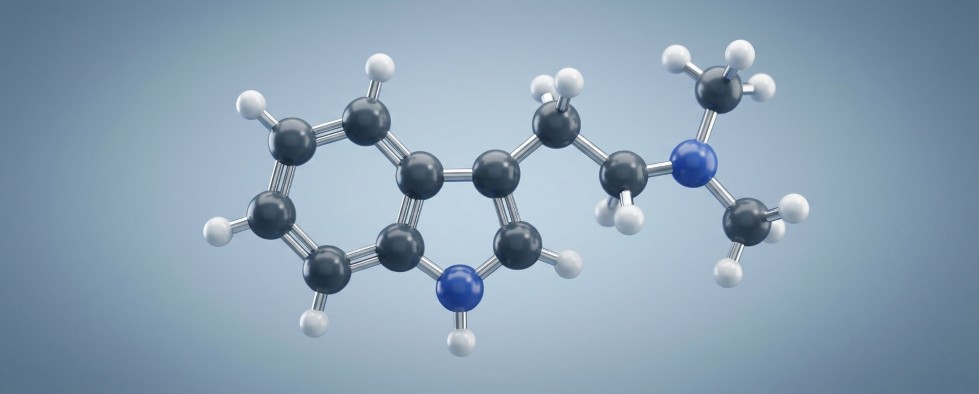
Anyone who has seen a picture of the DMT structure recognises the tryptamine family at once. The core is an indole ring — two fused ring structures — connected to a short side chain that ends in a nitrogen. In DMT, that nitrogen carries two methyl groups (the "N,N-di-methyl" in the name). In serotonin, the same position holds a hydroxyl group and some differently arranged atoms.
That explains why DMT and serotonin largely fit the same receptors. The most important one: the 5-HT2A receptor, a serotonin receptor heavily represented in the cerebral cortex. The same receptor is activated by psilocybin (the active compound in magic mushrooms), LSD, mescaline and all other classical psychedelics. It's no coincidence that these substances produce comparable baseline experiences — they literally engage the same lock.
What makes DMT distinctive within that family is the combination of molecular simplicity, rapid onset and rapid breakdown. The body breaks down free DMT within minutes via the enzyme monoamine oxidase (MAO), found in the gut and liver among other places. That rapid breakdown explains much of the short, intense character of the molecule.
Where DMT occurs — plants, animals, humans
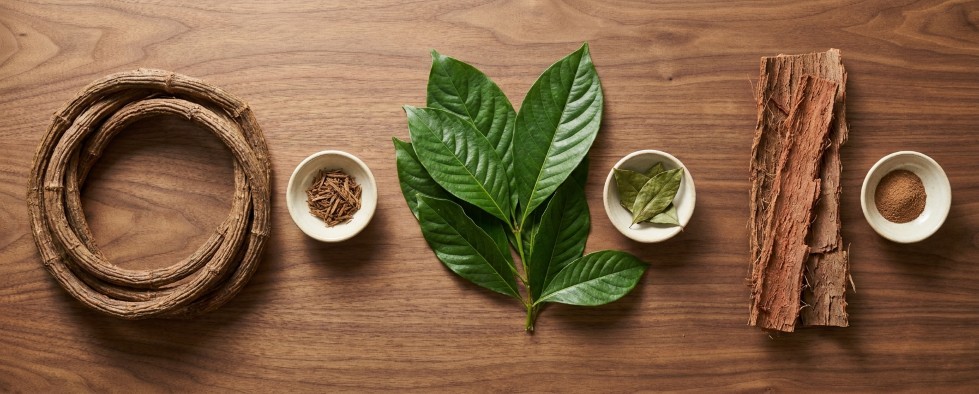
DMT is one of the most widespread alkaloids in the plant kingdom. It occurs in hundreds of species spread across dozens of plant families, often in very small quantities and rarely in extremely high concentrations. The best-known sources fall into three rough groups.
South American plants with traditional use. Here sits the heart of the known DMT culture. Psychotria viridis (Chacruna), Diplopterys cabrerana (Chaliponga) and Mimosa hostilis (Jurema) are known for their place in the ethnobotanical traditions of the Amazon. The vine Banisteriopsis caapi is regarded as a sacred plant by various peoples. Anadenanthera seeds (Yopo, Cebil, Vilca) contain different DMT variants and feature in the history of various Amazonian and Andean peoples.
Our guide on three sacred plants from the Amazon covers this family in detail.
Plants elsewhere in the world. Several Acacia species in Australia and Mexico naturally contain DMT, as do Phalaris grasses and a number of Mimosa and Desmanthus species outside South America. Virtually every continent harbours DMT-producing plants — implying the molecule is evolutionarily ancient.
Animals and humans. DMT has been detected in small amounts in mammalian brains, urine, blood and cerebrospinal fluid. In 2013 the group of Steven Barker (LSU) published a study consistently measuring DMT in rat brain, including in the pineal gland. A 2019 study by Jimo Borjigin (University of Michigan) showed that rat brains produce DMT during cardiac arrest — a finding that gave fresh fuel to the cultural hypothesis about DMT and near-death experiences. In humans, DMT has been measured at very low concentrations in the same body fluids. Whether that small endogenous amount has a physiological function, and if so which, is one of the most open questions in the entire field.
N,N-DMT, 5-MeO-DMT and DPT — three forms, three experiences
In the popular press, "DMT" is often discussed as if it were a single substance. In reality, multiple naturally occurring or synthetic tryptamines with comparable structure exist. Three are worth keeping apart.
N,N-DMT. The "classical" DMT, the molecule in ayahuasca and in most plants known for DMT. Effects are described by users as heavily visual, with geometric patterns, sensations of "encounter" with presences, and intense cortical-sensory shifts. Research by Rick Strassman in the 1990s mapped this experience for the first time systematically.
5-MeO-DMT (5-methoxy-N,N-dimethyltryptamine). A close relative but pharmacologically distinct molecule. Occurs in a number of plants and in conspicuously high concentrations in the skin glands of the Sonoran Desert toad (Incilius alvarius, formerly Bufo alvarius). The experience is described by users as less visual and more "non-dual" — closer to what mystical traditions describe than a visually overwhelming classical DMT trip. The Sonoran toad has come under pressure from over-harvesting for the western market; synthetic 5-MeO-DMT is the preferred variant in current therapy trials.
DPT (N,N-dipropyltryptamine). A synthetic analogue, not naturally occurring, with longer action than N,N-DMT. Used sparingly; in the United States, central to the rituals of the "Temple of the True Inner Light". Rarely appears in the wider DMT discourse.
When "DMT" is mentioned without further specification, it almost always refers to N,N-DMT.
How DMT works in the brain
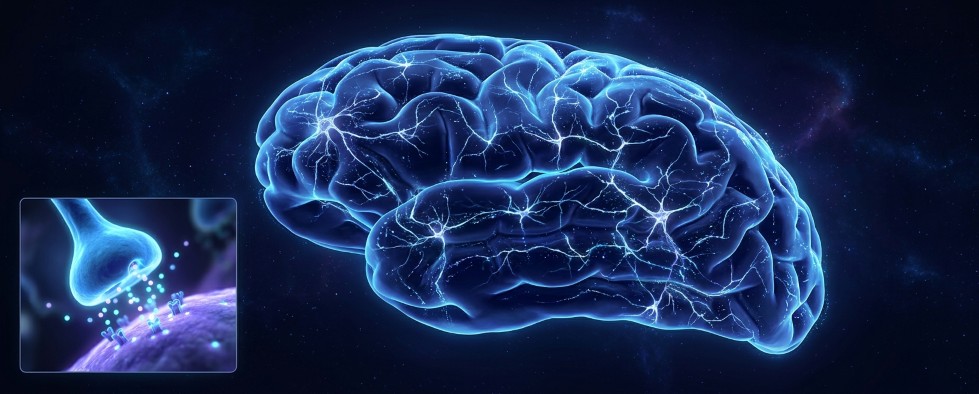
The biochemical workings of DMT are largely understood, the neurobiological effects increasingly so, and the subjective experience remains in many respects a mystery.
The molecule binds to several serotonin receptors, with the 5-HT2A receptor as the main actor. Activating it on the pyramidal neurons of the cerebral cortex raises glutamatergic transmission and changes how different brain regions communicate with one another. That effect has been measured in modern brain scans.
A team at Imperial College London led by Robin Carhart-Harris and Christopher Timmermann published a prominent study in 2023 analysing EEG measurements during DMT experiences. A striking finding: during peak effects, the hierarchical structure of brain activity changes dramatically. The normally clearly separated layers of neural processing move closer together and reorganise in a fundamentally different way. Other research groups, including Jimo Borjigin's at Michigan, have reported similar findings.
What this means for what a user experiences — the visual complexity, the sense of encounter, the loss of normal self — is at the level of mechanism not yet fully clear. The intersection of molecular pharmacology, network neurology and phenomenology is precisely what makes this field so lively.
Endogenous DMT — the molecule your body makes
One of the most discussed aspects of DMT in cultural discourse is the fact that it is produced in small amounts in the human body itself.
Synthesis runs through the enzyme INMT (indolethylamine-N-methyltransferase), present in lung, thyroid and brain tissue. The enzyme methylates tryptamine — a breakdown product of the amino acid tryptophan we obtain through food — into N,N-DMT. Studies have consistently measured endogenous DMT in blood, urine, cerebrospinal fluid and brain tissue, though at extremely low concentrations.
Here an interesting distinction emerges between what science can firmly support and what has grown larger in popular culture.
Scientifically well supported: DMT occurs in human tissue. The body possesses the enzymes to produce it. Concentrations are lower than what would cause a psychedelic experience.
Unproven but popular: Rick Strassman proposed in his book DMT: The Spirit Molecule (2001) the hypothesis that the pineal gland produces endogenous DMT and is responsible for dreams, mystical experiences, birth and death processes. To date that hypothesis is not scientifically confirmed. The pineal gland contains the necessary enzymes, but whether the organ actually produces DMT in functional quantities is unknown. Strassman himself repeatedly emphasises that his proposal is a hypothesis, not an established fact.
The 2019 research by Jimo Borjigin on rats in cardiac arrest added a new element: during cardiac arrest, his lab measures a strong spike in DMT production in the cerebral cortex. What that means for older hypotheses about DMT and near-death experiences remains an open question — interesting, but not yet conclusive.
A short history: from the Amazon to Imperial College
The history of DMT is in effect two stories that only met in the twentieth century.
The first story is that of the Amazonian peoples who have used DMT-containing plants for thousands of years. Archaeological finds in northern Chile and Bolivia have yielded ritual tubes and pollen with verifiable DMT residues, dated to roughly a thousand years old. Older traditions probably precede them but are harder to date archaeologically. The ayahuasca culture in Peru, Brazil, Colombia and Ecuador carries this knowledge to the present day. Banisteriopsis caapi is called "mother of all plants" by various tribes, a reference to the central place of the plant in their knowledge architecture.
The second story is that of western science. In 1931 the Canadian chemist Richard Manske isolated DMT from Acacia twigs. Manske at the time didn't know what he had in his hands. In 1956 the Hungarian psychiatrist Stephen Szára published the first systematic description of the psychedelic effects of DMT after self-experiments — Szára had no access to LSD, which Sandoz tightly controlled, and looked for a working alternative. His observations formed the first western psychedelic DMT research.
After a long gap — the worldwide hardening of drug laws in the 1960s essentially stopped psychedelic research — DMT returned to view in the 1990s. Rick Strassman received DEA permission in 1990 to conduct a five-year study in which healthy volunteers were given standardised doses of DMT in a clinical setting, with systematic recording of the experience. His 2001 book DMT: The Spirit Molecule spread these data and placed DMT on the mental map of the modern psychedelic renaissance.
The 2000s brought reopened research programmes at Johns Hopkins, Imperial College London and many other universities. Terence McKenna, ethnobotanist and cultural philosopher, played his own role in conveying Amazonian DMT knowledge to a western audience. From around 2015 onwards, scientific DMT research scaled rapidly, particularly from British and Spanish laboratories.
DMT in 2026: the mainstream moment
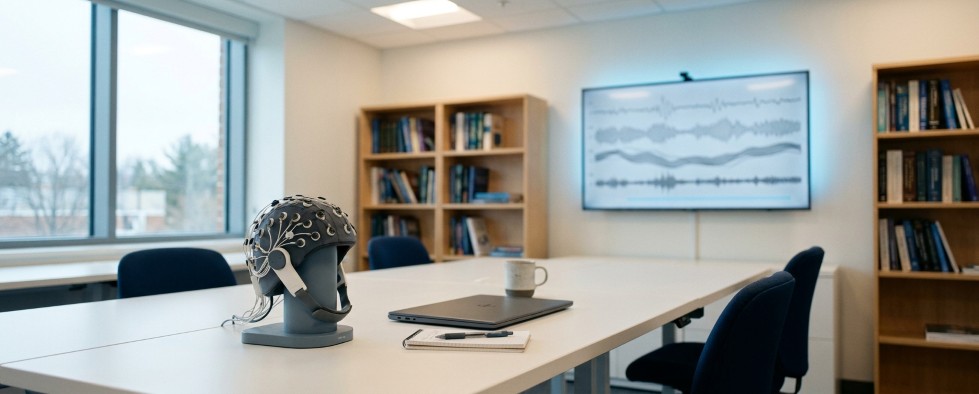
Until around 2018, DMT was largely a subcultural phenomenon — known in psychedelic and Amazonian ceremonial circles, marginal in scientific discourse, virtually invisible in mainstream press. That has changed fundamentally in the years since.
A few forces contributed. Long-running podcasts with large audiences — Joe Rogan, Lex Fridman, Andrew Huberman — devoted hours-long episodes to DMT, often with researchers like Carhart-Harris, Strassman or Borjigin as guests. Documentaries such as the Strassman-book-based DMT: The Spirit Molecule (2010) reached large audiences through streaming. Clinical trials for DMT analogues as treatment for depression — conducted by companies like Small Pharma in England — reached news outlets. Ayahuasca tourism to Peru and Brazil grew. The wider psilocybin and MDMA therapy renaissance pulled DMT along in its slipstream.
What that means for the cultural moment: a molecule previously dismissed as esoteric is now taken seriously by researchers, journalists and health professionals. At the same time, unreliable information spreads through the same channels as quickly as the good information. It is a phase in which nuance and factual grounding matter more than they ever have.
DMT and the law
Is DMT legal? In short: as a pure substance, DMT is controlled, listed under list I of the Dutch Opium Act.
Why Next Level Smart?
- More than 10 years of experience in ethnobotanical products, not a supplier that just jumped on a trend
- A broad, carefully curated range of ethnobotanical plants
- Transparent on sourcing — clarity on where each plant comes from and how it was gathered
- Discreet shipping across the Netherlands and Europe
Important: our ethnobotanical plants are offered strictly for research, botanical study and collecting purposes.
Further reading
For anyone wanting to dig deeper into the plants themselves: our guide on three sacred plants from the Amazon covers Caapi, Chacruna and Mimosa Hostilis individually. For anyone wanting to understand Terence McKenna's role in the DMT discourse: our portrait of Terence McKenna. For the wider context of the current psychedelic therapy renaissance: our piece on psilocybin therapy and the worldwide shift.
A final thought: for a molecule that has been in western laboratories since 1931, DMT has only just begun its intellectual life. The coming decade will answer more than the past six did — and probably raise plenty of new questions of its own. What it is, we know reasonably well. What it tells us about the brain and consciousness, we are only just starting to learn.
What does DMT stand for?
DMT stands for N,N-dimethyltryptamine. It's a tryptamine — a family of molecules structurally related to serotonin, the neurotransmitter in your own brain. The molecule consists of an indole ring (two fused ring structures) with a short side chain and two methyl groups on a nitrogen atom.
Is DMT legal in the Netherlands?
As a pure substance, DMT is listed under list I of the Dutch Opium Act and is therefore controlled.
What's the difference between N,N-DMT and 5-MeO-DMT?
Two related but pharmacologically distinct molecules. N,N-DMT is the "classical" DMT, the molecule found in ayahuasca and in various Amazonian plants. 5-MeO-DMT (5-methoxy-N,N-dimethyltryptamine) occurs in a number of other plants and in conspicuously high concentrations in the skin glands of the Sonoran Desert toad. The subjective experiences are described differently by users: N,N-DMT as heavily visual, 5-MeO-DMT as less visual and more "non-dual".
Does the human body produce DMT itself?
Yes, in very small amounts. The enzyme INMT (indolethylamine-N-methyltransferase) sits in lung, thyroid and brain tissue and can convert tryptamine into N,N-DMT. Studies have consistently measured endogenous DMT in blood, urine and cerebrospinal fluid. The concentrations are lower than what would cause a psychedelic experience. Whether that small endogenous amount has a function is one of the most open questions in the field.
Is the DMT-and-pineal-gland story true?
Partially. It's a hypothesis Rick Strassman proposed in his book DMT: The Spirit Molecule (2001). The pineal gland does contain the necessary enzymes to produce DMT. Whether the organ actually produces DMT in functional quantities is not scientifically established. Strassman himself repeatedly emphasises that his proposal is a hypothesis. In cultural discourse the story often takes on a life of its own that goes further than the data supports.
How long does DMT last?
Free DMT is broken down quickly by the enzyme monoamine oxidase, which makes the molecule short-acting. That short but intense profile is one of the reasons DMT draws so much scientific attention.
What's the relationship between DMT and ayahuasca?
Ayahuasca is a traditional Amazonian brew that holds an important cultural and spiritual place in ceremonial contexts, and in which DMT-containing plants occur. We do not go into how it is prepared: making a DMT-containing preparation falls under the Dutch Opium Act. This guide focuses on the DMT molecule and the science around it.
What is a DMT "breakthrough"?
A term from popular discourse used to describe the most intense form of a DMT experience — a threshold at which the normal sense of self and visual perception are completely replaced by a fundamentally different experience. It's an experiential category from popular discourse, not a scientific term.
Is DMT being used in modern therapy?
Since 2020 several clinical trials have explored DMT and DMT analogues as potential treatments for depression and related disorders. Companies like Small Pharma (England) and Cybin are working on shorter-acting analogues that are more practical in a clinical setting than a hours-long ayahuasca session. None of these treatments have been approved for regular medical use in the Netherlands as of 2026.
Why is DMT suddenly so much in the news?
A convergence of factors. Podcast culture (Joe Rogan, Lex Fridman, Andrew Huberman) has introduced DMT to a broad audience. Clinical trials put the substance in mainstream news. The wider psilocybin and MDMA therapy renaissance pulls DMT along. Ayahuasca tourism has grown. And science itself is producing findings at an accelerating pace — about endogenous DMT, about brain activity during the experience, about potential therapeutic applications.
Last updated: June 2026 | Next Level Smart
Lex Johnson is a self-taught herbalist, language freak, musician and one of the writers behind the Next Level blog. His curiosity runs wide — from the differences between Criollo and Trinitario cacao to the latest psilocybin research.
That same curiosity shows in the range of his writing. Lex covers everything from ceremonial cacao and kanna to magic mushrooms, salvia divinorum, kambo, party pills, healing herbs and product deep dives.
In addition to a journalism foundation certificate, he holds a Bachelor of Fine Arts.